
AI SEO Agency vs In-House: Why You Should Start In-House First


TL;DR
An AI SEO agency optimises your brand to get cited and recommended by ChatGPT, Perplexity, Gemini, and Google AI Overviews. Hiring one is a good move, but not your first move. Spend a few weeks doing it in-house first: run your own brand through an AI visibility tool, fix the obvious gaps, and learn what "good" looks like. Then you hire from a position of knowledge. You brief better, you spot the agencies selling vague promises, and you only pay an agency to do what you genuinely cannot do yourself.
I have spent years running SEO and content for SaaS and tech companies, and I have sat on both sides of this decision: building it in-house and briefing agencies. What follows is the honest version, the one I would give a marketing manager at a scaling company who is about to sign a retainer. The smarter path for most teams is to start in-house, build a baseline understanding, and use that knowledge to hire the right agency later, if you still need one.
What an AI SEO agency actually does
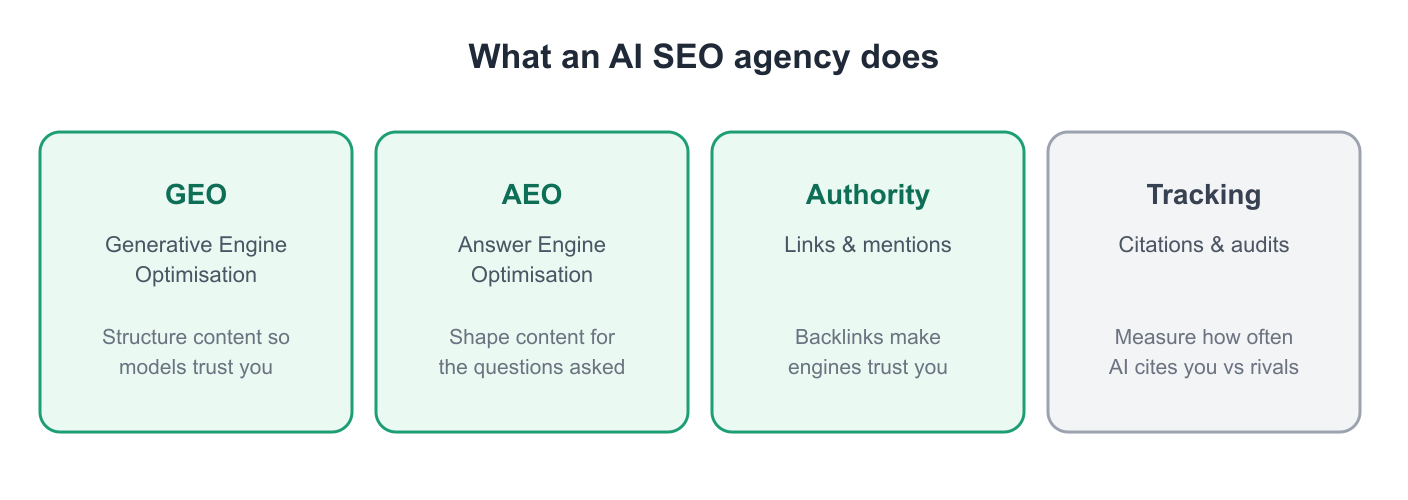
An AI SEO agency is a firm that optimises your brand to be cited and recommended inside AI-generated answers, on engines like ChatGPT, Perplexity, Gemini, and Google AI Overviews, rather than only ranking in the classic blue links. Worth knowing before you compare: the majority of AI SEO agencies are SEO agencies that added GEO to their offering, not a new breed of company. The work splits into four jobs:
- Generative Engine Optimisation (GEO): structuring your content, entities, and schema so large language models can parse and trust your brand.
- Answer Engine Optimisation (AEO): shaping content around the conversational questions people actually ask, so you get pulled into the answer.
- Authority and backlinks: earning the links and mentions that make engines rate you a credible source in the first place. This is the classic SEO muscle, and AI engines lean on it as heavily as Google does.
- Tracking and audits: measuring how often AI engines cite you, for which prompts, and how that compares to competitors.
None of this is magic. Most of it is disciplined content, authority, and technical work applied to a new surface. That matters, because the moment you understand the four jobs, you can judge whether an agency is doing them well or just repackaging old SEO with a new label.
That the badge is mostly SEO agencies is not automatically bad. GEO is built on SEO, and a solid backlink strategy is a core part of it, so an experienced SEO shop already has the right foundation. But it means the label tells you little on its own. Some are genuine specialists, others relabelled a service deck last quarter. Knowing the basics yourself is how you tell which is which.
GEO is built on SEO, so a new domain starts with SEO
Here is the part the AI-hype skips. GEO does not replace SEO, it sits on top of it. AI engines pull from the same web they always did: they read your pages, weigh your authority, and lift the sources they trust. If those pages are thin, unlinked, and invisible in classic search, there is nothing for an AI engine to cite in the first place.
That order matters most for a new or low-authority domain. In my experience, if you launch on a fresh domain and jump straight to GEO tactics, you are decorating a house with no foundation. Get the SEO fundamentals in first: crawlable pages, clear structure, real content that answers real queries, and enough authority that engines take you seriously. Then layer GEO on top to win the citation.
So the sequence is:
- New domain: fix SEO fundamentals first, indexing, structure, content, links.
- Existing domain with SEO in place: layer GEO on top, structure answers for AI, track citations.
- Both: keep them running together, because the same content work feeds both.
The upshot: if someone tries to sell you GEO for a brand-new site with no SEO foundation, that is a flag. The foundation comes first.
The honest answer: it depends on budget, goals, and speed
Whether you go in-house or hire an agency is not a fixed rule. It depends on three things, and any honest answer starts here:
- Budget. A tool subscription plus your own time costs a fraction of an agency retainer. If budget is tight, in-house is not a compromise, it is the sensible start.
- Goals. If the goal is to learn the space and win a few clear gaps, in-house does it. If the goal is aggressive volume across dozens of pages, an agency's team moves faster.
- Speed. This comes down to how fast you need results and how much of your own week you can give it. In-house is slower per hour but starts today. An agency adds capacity but adds onboarding time before anything ships.
Map your situation against those three and the answer usually picks itself. For most marketing managers at a scaling company, the honest read is: start in-house to learn, then spend agency budget only where budget, goals, and speed all point that way.
The honest comparison: in-house vs agency
| Factor | In-house | AI SEO agency |
|---|---|---|
| Upfront cost | Low. Time plus a tool subscription | High. Monthly retainers, often multi-month |
| Speed to start | Same day. You control the calendar | Slower. Onboarding, audits, approvals |
| Learning | Builds lasting in-house knowledge | Knowledge leaves with the contract |
| Control | Full. You see every change | Partial. You approve, they execute |
| Scale | Limited by your hours | High. A team moves faster on volume |
| Risk | Might miss advanced tactics | Might overpay, or hire the wrong team |
The table has no single winner, and that is the point. In-house wins on cost, speed, and learning. An agency wins on scale and depth once the basics are handled. The mistake is skipping straight to the agency column before you understand the in-house one.
Why you should start in-house
You learn what good looks like. When you have run your own AI visibility check and fixed a few gaps yourself, you develop a reference point. You know roughly how long a content fix takes and what moves the needle. That reference point is the single best defence against being oversold.
You cannot be sold vague promises. The AI SEO space is new and noisy. Plenty of agencies lean on jargon because the buyer cannot tell the difference. Once you have done the work, "we will improve your GEO signals" stops sounding impressive and starts sounding like something you can ask hard questions about.
The early wins are genuinely DIY. A lot of first-round AI SEO is achievable in-house: cleaning up your most-cited pages, adding clear answers to common questions, fixing schema, and making sure your key facts are stated plainly enough for a model to lift. You do not need a retainer to do any of that.
You keep the knowledge. An agency's understanding of your brand walks out the door when the contract ends. Knowledge you build in-house stays and compounds.
Try the tool yourself first
Before you decide who owns SEO and GEO, whether that is you, a new in-house hire, or an agency, look at your own data. This is the single thing I recommend most: start small yourself with a tool, get the visibility data, and let it teach you the space. You cannot brief anyone well on a problem you have never seen.
The fastest way to learn the basics is to look at your own data before anyone else does. Run your brand through an AI visibility tool and see the reality: which prompts mention you, which cite a competitor instead, and which pages AI trusts but never links to.
This is where AllSearch fits. Point it at your brand and you get a free AI visibility report in under 60 seconds, after a short setup. It shows where you stand across ChatGPT, Perplexity, Gemini, Google AI Overviews, and Google AI Mode, and it names the exact sources AI cites, not just a score.
From there the in-house workflow is straightforward:
- See the gaps. Find the prompts where a competitor gets cited and you do not.
- Fix the obvious ones. Use AEO content strategy to decide what to write and optimise, then update the pages that matter. If you need the copy, the AI content creation tool turns the gap into a draft.
- Track whether it worked. Re-check your visibility and watch which fixes actually changed your citations.
Do one full loop of that yourself. Even if you eventually hire an agency, you now know what the tool shows, what a real fix looks like, and what results to expect. That is knowledge no pitch deck can give you.
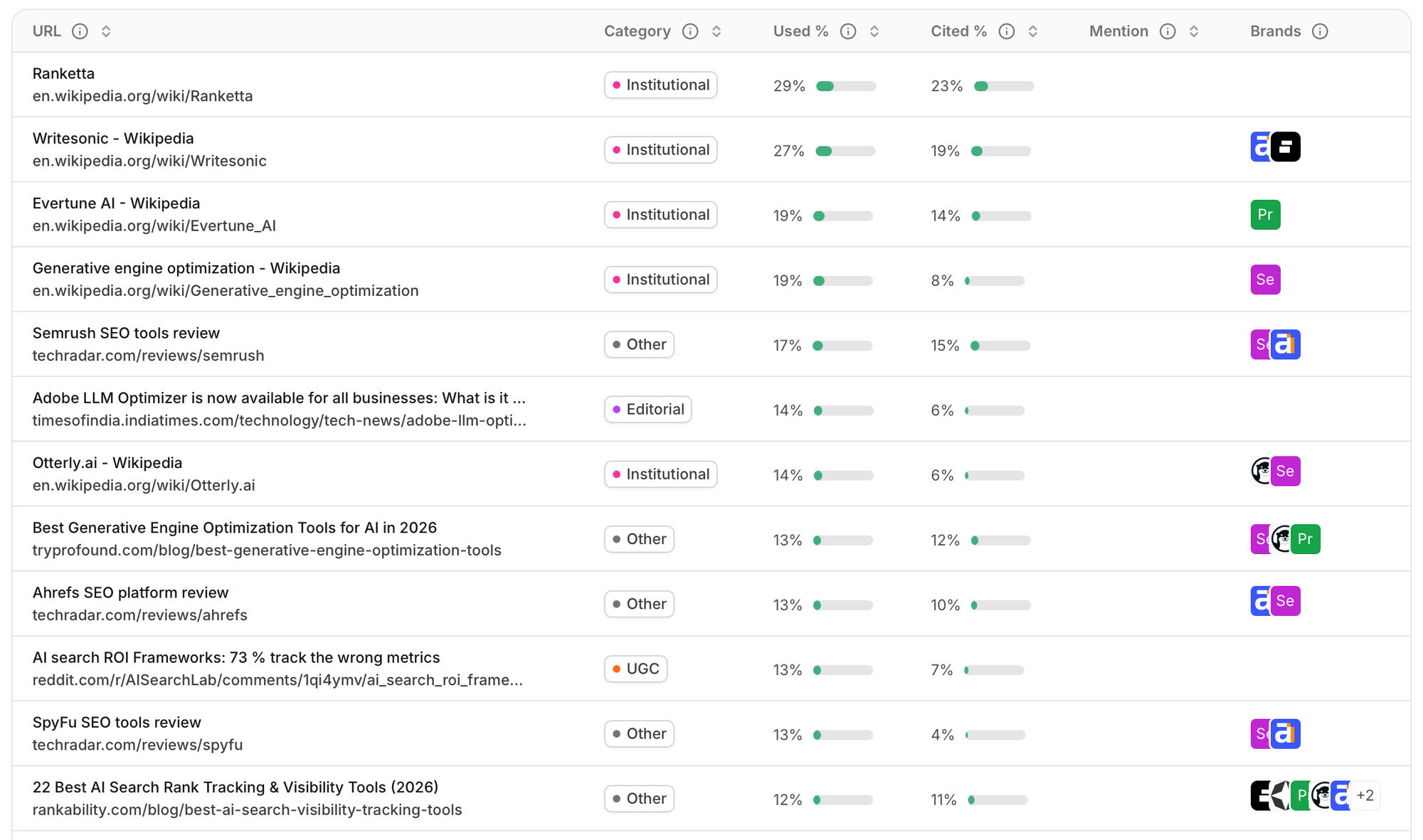
AllSearch shows the exact pages AI engines cite, so you can see where you are missing.
When to bring in an agency, and how to pick one
In-house has limits. Once you have handled the basics, an agency earns its fee when:
- You need volume you cannot produce with your own hours.
- You need technical depth beyond your team, such as large-scale schema or site architecture.
- You want an outside audit to pressure-test what you have built.
If that is you, the in-house months pay off at the hiring stage. Use what you learned to vet candidates:
- Ask them to name the metric. A good agency talks about specific citations, prompts, and sources, not "AI visibility" in the abstract.
- Ask what they would do in month one. A generic audit with no specifics about your gaps means they have not looked. You already know your gaps.
- Ask which engines they track and how. You know the real ones: ChatGPT, Perplexity, Gemini, Google AI Overviews, Google AI Mode. Vague answers are a red flag.
- Ask to see a sample report. Compare it to what you already generated yourself. If theirs tells you less, that tells you plenty.
You brief better, negotiate better, and buy only what you actually need. That is the whole return on starting in-house.
The hybrid model most teams land on
The endgame is rarely purely in-house or purely agency. It is usually this: your team owns strategy and tools, the agency scales execution.
You keep the AI visibility tracking in-house so you always know your own numbers and never depend on an agency to mark its own homework. The agency handles the heavy lifting you brief them on. You stay in control because you understand the work, and they add capacity because they have the team.
That balance is only possible if you learned the fundamentals first, which is exactly why in-house comes before the agency, not instead of it.
The fundamentals have not changed: know the questions your buyers ask, answer them better than anyone, and measure what works. What changed is the surface. Being thorough now means being the source AI engines cite, not just the top blue link, and the fastest way to learn that surface is to look at your own data before anyone else does. Start in-house, run one full loop yourself, then hire from knowledge. That order is the whole edge.
FAQ
Can I do AI SEO myself?
Yes, for the fundamentals. Running an AI visibility check, fixing your most-cited pages, adding clear answers to common questions, and tidying schema are all achievable in-house with a tool and some time. Agencies add the most value on scale and advanced technical work, once the basics are handled.
Is an AI SEO agency worth it?
It can be, but not as a first step. Start in-house, learn what good looks like, and hire an agency only for the work you genuinely cannot do yourself. Hiring before you understand the basics is how teams overpay and pick the wrong agency.
How much does an AI SEO agency cost?
Agencies typically work on monthly retainers, often with multi-month commitments, so the cost is much higher than a tool subscription plus your own time. Doing the fundamentals in-house first lets you spend an agency budget only where it earns its keep.
What is the difference between AI SEO and traditional SEO?
Traditional SEO optimises for ranking positions in the classic list of blue links. AI SEO optimises for being cited and recommended inside AI-generated answers on engines like ChatGPT, Perplexity, Gemini, and Google AI Overviews. The disciplines overlap, but the surface and the measurement are different.
Should I do SEO or GEO first on a new website?
SEO first. GEO is built on top of SEO, not instead of it. AI engines read and cite the same web that classic search ranks, so a new domain with thin content and no authority gives them nothing to cite. Get the SEO fundamentals in first, indexing, structure, content, and links, then layer GEO on to win the citation.
Should I hire an agency or build an in-house team?
For most teams, start in-house with one person and a tool, learn the fundamentals, then decide. If you later need volume or technical depth beyond your team, hire an agency. The hybrid model, in-house owns strategy and tools while an agency scales execution, is where most teams end up.