How to Track Your Brand in Google AI Overviews (AIO Tracking)

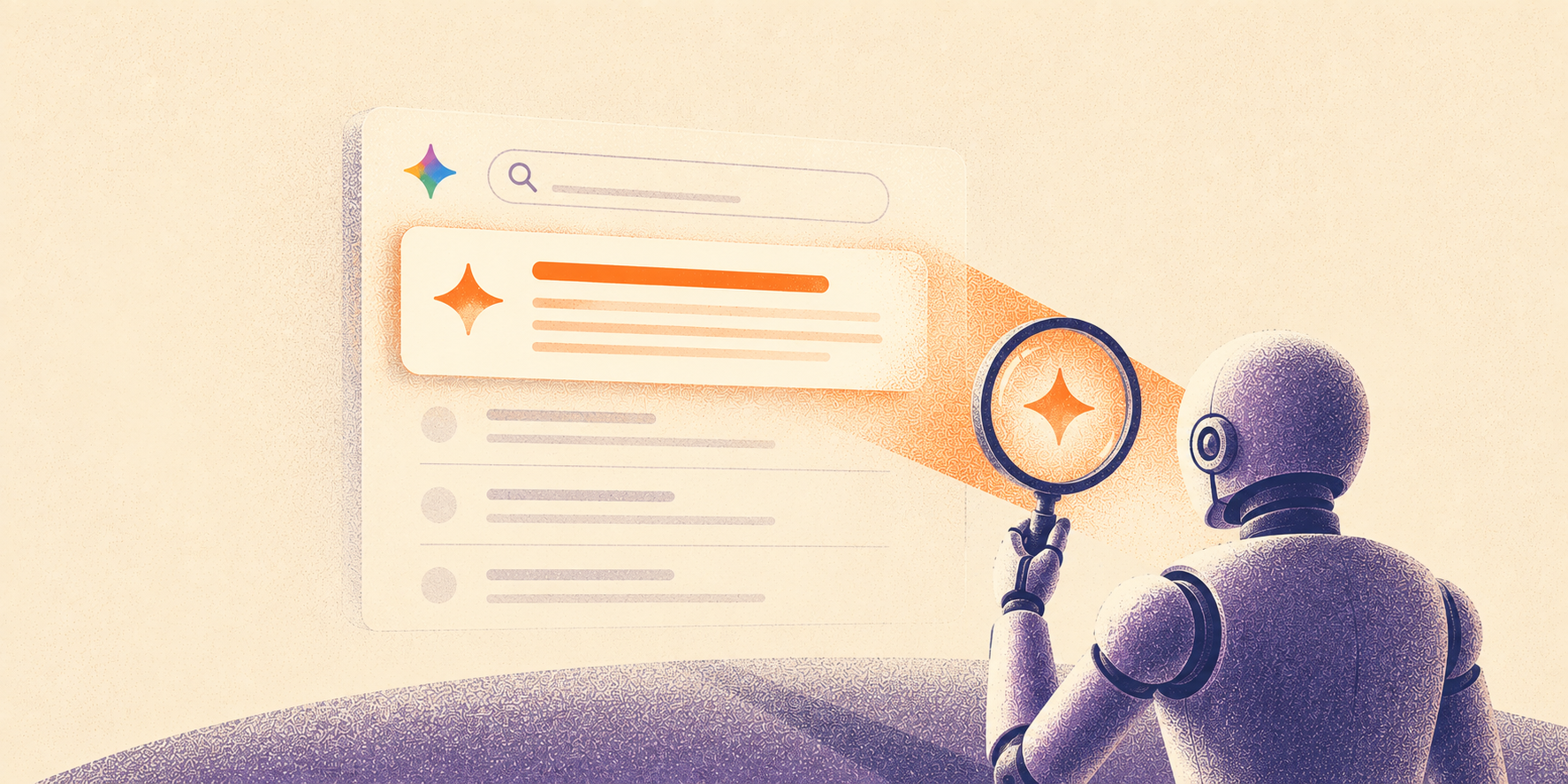
TL;DR: Google AI Overviews appear at the top of search results when Google determines it has synthesized an answer to your query. Instead of clicking through ten blue links, users get a summarized answer, often with inline citations. For brands, this shift transforms visibility. You're no longer competing for position 1-10; you're competing to be cited inside a gray box that answers the query directly. AIO tracking isn't optional anymore. It's how you measure whether your content reaches your audience in 2026.
- What: AIO tracking monitors whether your brand is cited in Google AI Overviews (also called "AI overview tracker" or "AI visibility tracking").
- Why: AI Overviews answer queries before users click. Being cited drives visibility even if your organic ranking drops.
- How: Use free methods (Google Search Console + GA4) or paid tools (AllSearch, SE Ranking, LLM Pulse) to track citations across Google, ChatGPT, Perplexity, and Gemini.
- Action: Start with free methods. Move to paid tools when you're tracking 100+ keywords or multiple AI models.
Why AIO Tracking Matters
For decades, SEO was simple: rank higher, get more clicks. That assumption is breaking.
Google is aggressively expanding AI features. AI Overviews now appear on 50-90% of queries depending on geography and query type. AI Mode offers a paid alternative to ChatGPT. Gemini, Perplexity, and Claude track queries millions of users search every day. The result: visibility is moving above the fold, but traditional rank trackers don't capture it.
Three reasons why AIO tracking matters:
1. Visibility moves above the fold. When Google shows an AI Overview, your rank tracking still shows "position 5" or "position 8." But users see the synthesized answer first. If your site is cited in that overview, you have above-the-fold visibility that rank trackers ignore. You're competing for citation, not position.
2. Click patterns are changing. Zero-click risk is real. For fully-answered queries (health symptoms, recipe ingredients, how-to steps), users get their answer in the AI Overview and leave. They don't click. Being cited helps: cited sources outperform non-cited sources. But clicks can still drop 30-50% for queries with comprehensive AI answers. You need to measure this.
3. Competitive intelligence is harder without AIO data. Your competitor ranks position 3 in organic. You rank position 1. But if the AI Overview cites your competitor and ignores you, your competitor is winning. Rank tracking tells you half the story. AIO tracking tells you which sources actually reach your audience first.
How AIO Tracking Works: A 4-Step Workflow
Most AIO tracking tools share a common workflow, though implementation varies:
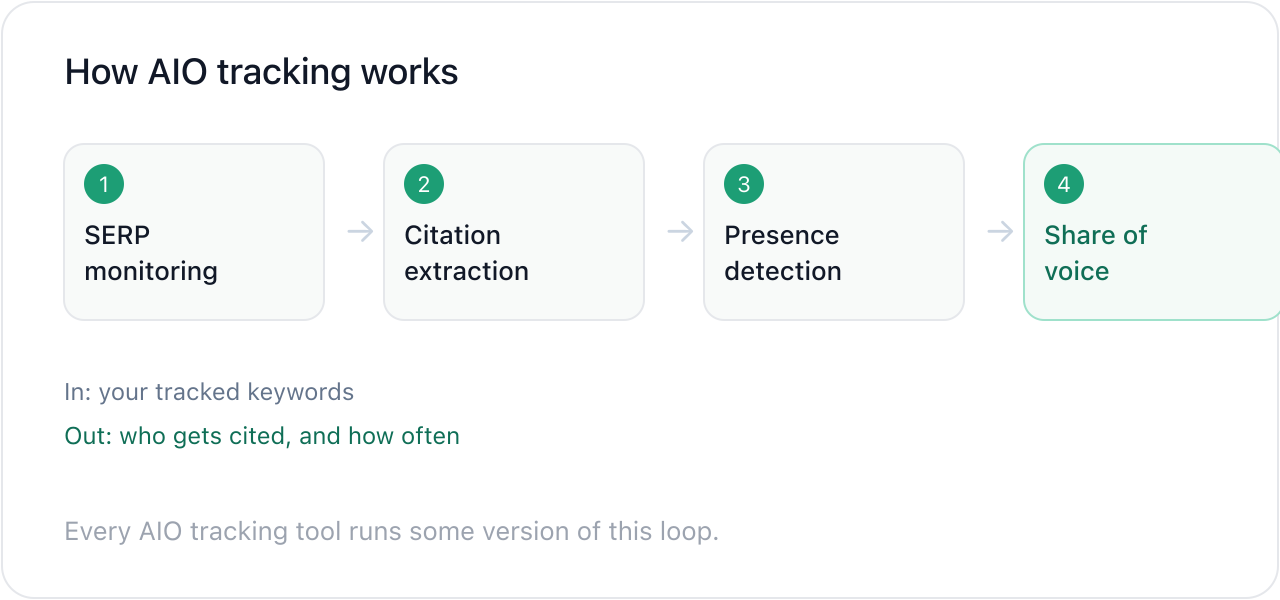
Step 1: SERP Monitoring
Your tracked keywords are searched on Google. The tool captures the full SERP, including the AI Overview block (if one appears).
Step 2: Citation Extraction
The AI Overview text is parsed to identify every cited source. Each URL is extracted and matched to your brand. Some tools go deeper and extract sentiment (is the citation positive, neutral, or negative?).
Step 3: Presence Detection
For each keyword, the tool records: Is your brand cited? Is your brand mentioned by name (without a link)? Or is your brand absent from the AI answer? This presence/absence data becomes the foundation of your tracking.
Step 4: Competitive Share-of-Voice (SOV)
Aggregating citation data across all your tracked keywords gives you a share-of-voice metric: Out of all the domains cited in AI Overviews for your keywords, what percentage are yours? This lets you benchmark against competitors.
Free AIO Tracking Methods
Before buying a tool, start free. If you have fewer than 100 keywords or want to test the concept, these methods work.
Method 1: Google Search Console
What to look for:
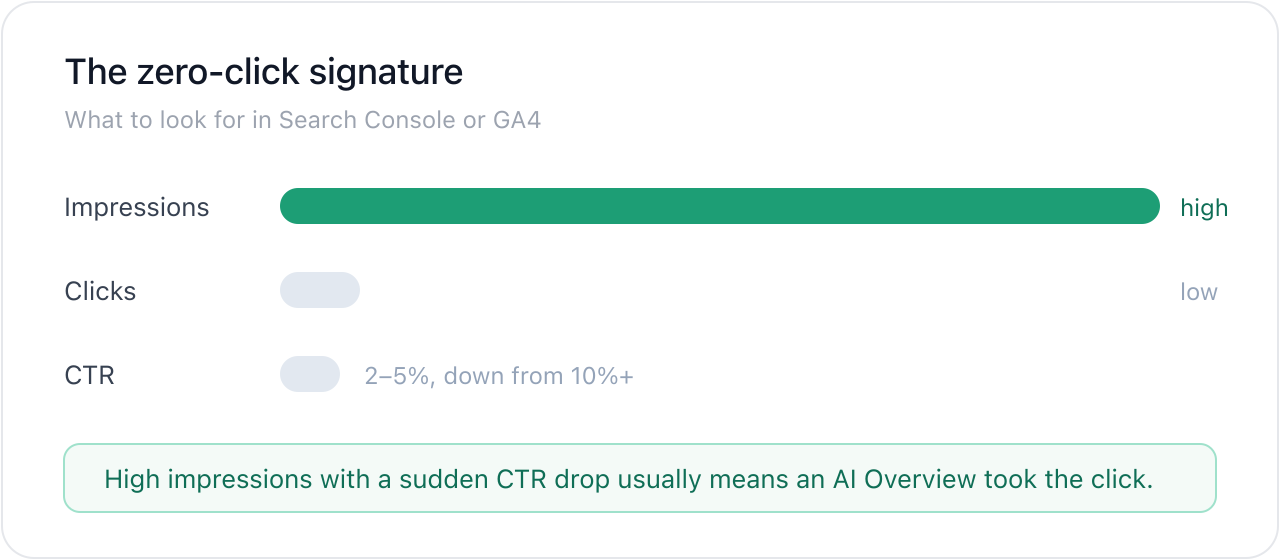
- Queries where your impressions are high but clicks are very low (classic zero-click AIO signature)
- Queries where your position is 5-10 but you still get impressions (you're likely cited in an AI Overview)
- CTR anomalies: Queries that usually get 10% CTR but suddenly drop to 2% (AIO appeared and took clicks)
Method 2: Google Analytics 4
Create a custom dimension called "Query Type" and set up events for high-impression, low-click queries. This connects AIO tracking to business outcomes. You can measure actual traffic lift from citations.
Method 3: Manual Monitoring
Create a Google Sheet with your keywords. Every Monday, search each keyword in Google, screenshot the SERP, and track which domains are cited. Free and revealing.
| Keyword | AIO present? | Cited URLs | CTR change |
|---|---|---|---|
| best running shoes | Yes | nike.com, runnersworld.com | -18% |
| how to fix a leaky faucet | Yes | thespruce.com | -32% |
| best crm for startups | No | N/A | 0% |
AIO Geography: Where AI Overviews Appear
AI Overviews don't appear equally across all markets. Google's rollout is uneven, and query types trigger different AIO prevalence by region.
| Region | AIO Prevalence | Zero-Click Risk | Impact |
|---|---|---|---|
| United States | 50-70% | High | Most queries trigger AIO. Organic CTR down 15-25%. |
| United Kingdom | 40-55% | High | Close behind US. Similar zero-click trend. |
| Canada | 35-50% | Medium-High | Trending up. Watch for changes quarterly. |
| European Union | 20-35% | Medium | Slower rollout. Regulatory delays. AIO less common. |
| APAC | 10-25% | Low | Limited AIO. Traditional rank tracking still dominant. |
What this means: If you're US-focused, AIO tracking is urgent. If you're APAC-focused, AIO matters less (for now). Your geography shapes your strategy.
The Zero-Click Reality: How AI Overviews Are Cannibalizing Organic Traffic
Here's the uncomfortable truth: When Google shows an AI Overview, clicks often stop.
Data point: For queries with comprehensive answers (recipes, symptom checkers, how-to steps), CTR drops an average of 30-50% when an AI Overview appears. Being cited helps: cited sources still outperform non-cited. But the click pie is shrinking.
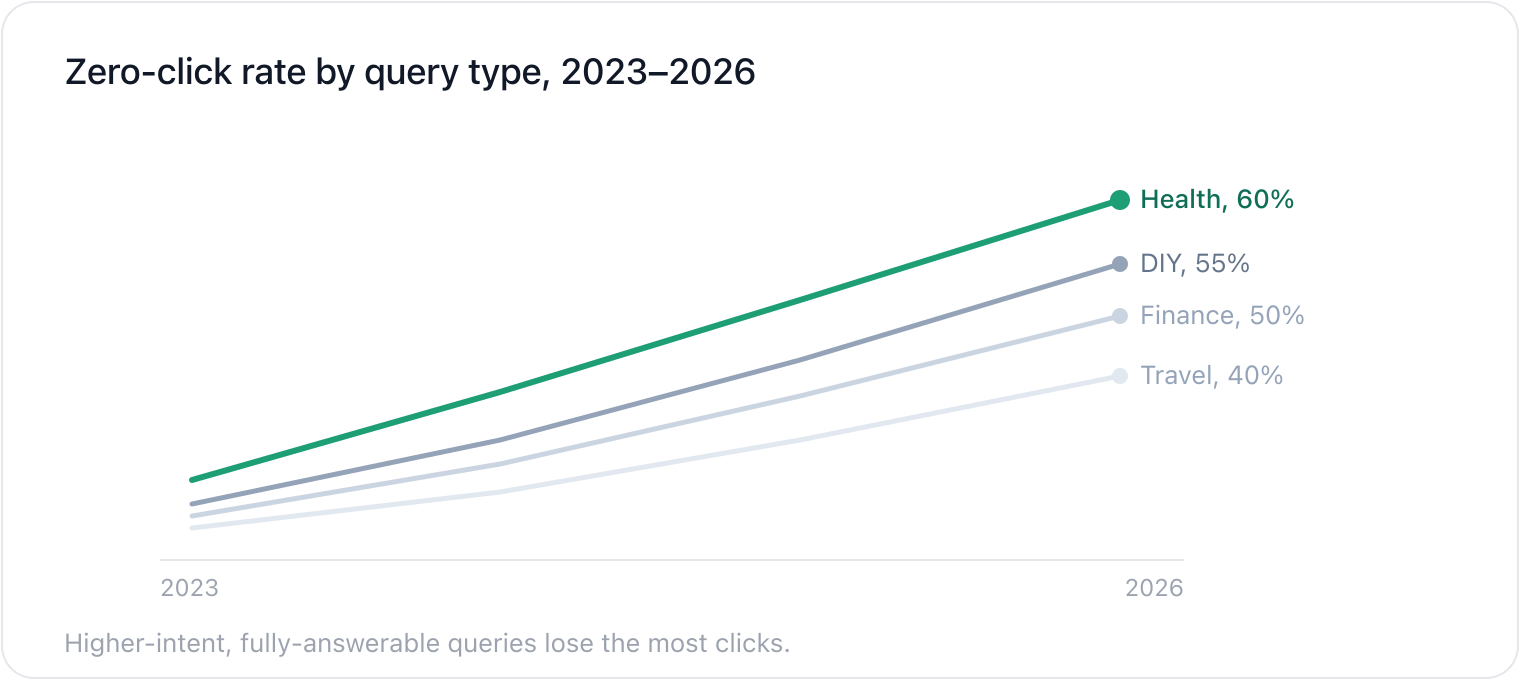
Query types hit hardest by zero-click:
- Health ("symptoms of X", "treatment for Y")
- DIY/how-to ("how to fix", "how to build")
- Recipe/ingredient lookups
- Travel ("best time to visit", "where to eat")
- Finance ("average cost of", "how much is")
The trend: Google is accelerating AI features. AI Mode now competes with ChatGPT. The zero-click trend isn't stopping. It's accelerating.
Multi-Engine Tracking: Beyond Google AI Overviews
If you only track Google, you're missing 60% of your AI visibility.
Millions of users search ChatGPT, Perplexity, Gemini, and Claude daily. These engines cite sources differently than Google.
| Engine | Citation Style | Click Potential |
|---|---|---|
| Google AI Overviews | Blue links in gray box | Medium (0-20% CTR) |
| ChatGPT | Numbered citations | Medium (20-40% CTR) |
| Perplexity | Linked sources | Medium (15-35% CTR) |
| Gemini | Synthesized mentions | Low-Medium |
| Claude | Strong citation signals | Medium (15-25% CTR) |
Why single-engine tracking fails: You rank for a keyword in Google AI Overviews but don't appear in Perplexity's answer to the same query. You lose 30% of your potential visibility. Multi-engine tracking captures your complete picture.
AllSearch: The Multi-Engine Solution
Tracking one engine only tells half the story. A page that gets cited constantly in ChatGPT can be invisible in Google's AI Overviews for the exact same query, and the reverse happens just as often. AllSearch tracks Google AI Overviews, Google AI Mode, ChatGPT, Perplexity, and Gemini together, so that correlation is visible directly: which engines pick up a given piece of content, which ones only mention the brand without citing it, and which ones miss it entirely.
That comparison matters more than any single engine's number. A brand cited in three out of five engines for a topic has a defensible position. A brand cited in one, even a high-volume one, is one algorithm update away from losing that visibility. Tracking usage, citation, and mention per engine, not just as an overall average, is what turns a single data point into a real read on where content is getting picked up and where it still needs work.
Key AIO Metrics Explained
If you don't measure these, you're flying blind. Most AIO tracking tools, AllSearch included, break citation data down into three numbers: usage, citation, and mention.
Usage is how often a source shows up at all when an AI model answers your tracked prompts, whether it's linked or not. A high usage percentage means the model treats that page as a go-to reference for the topic, even before you look at whether it gets a citation.
Citation is the tighter number: how often that source is actually linked as a citation in the AI answer, not just used to shape it. Citation is always equal to or lower than usage, since a source can inform an answer without being credited for it.
Mention tracks something different again: whether a specific brand is named within a source the AI is drawing from, and how prominently. AllSearch ranks this 1st, 2nd, or 3rd, because primacy affects how much of the click a mention actually captures.
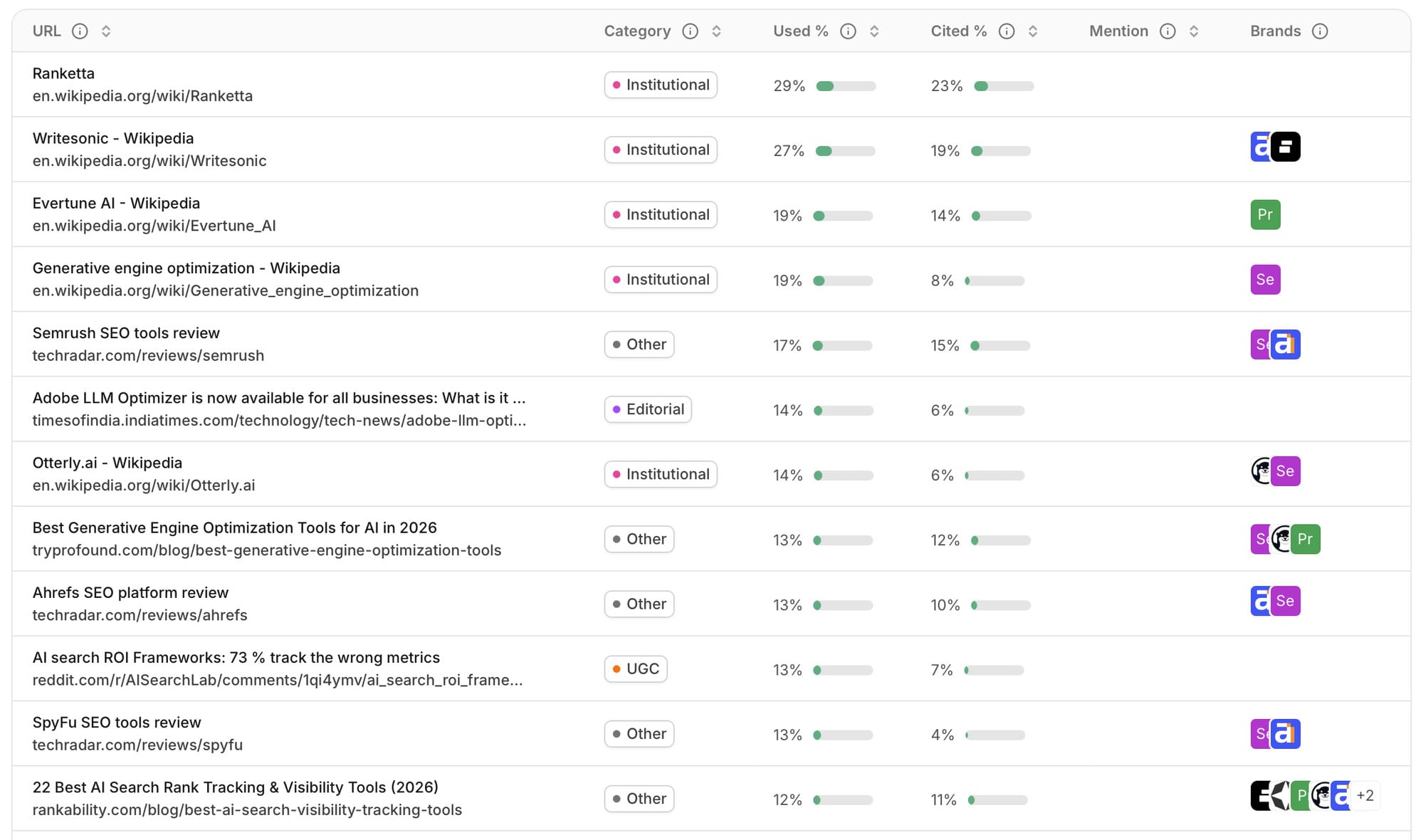
Reading a row like this tells you two things at once. A domain with high usage but a lower citation rate is shaping the model's answer without earning a link back. That's worth studying even if you have no citation of your own yet. A domain where usage and citation sit close together is a source AI models treat as citation-worthy nearly every time they draw on it.
The mention rank is the actionable one. If your brand shows up 2nd or 3rd inside a source that's cited often, the fix isn't to chase a citation of your own. It's to get closer to 1st inside a source AI already trusts. That's a different kind of work than link building, and traditional rank trackers have no equivalent metric for it.
Action: Sort your cited-domains report by usage. Anywhere usage is high and your brand's mention is missing or ranked low, that's a content gap worth closing, not on your own site, but through the source AI keeps returning to.
Content Optimization for AI Overviews: 5-Step Playbook
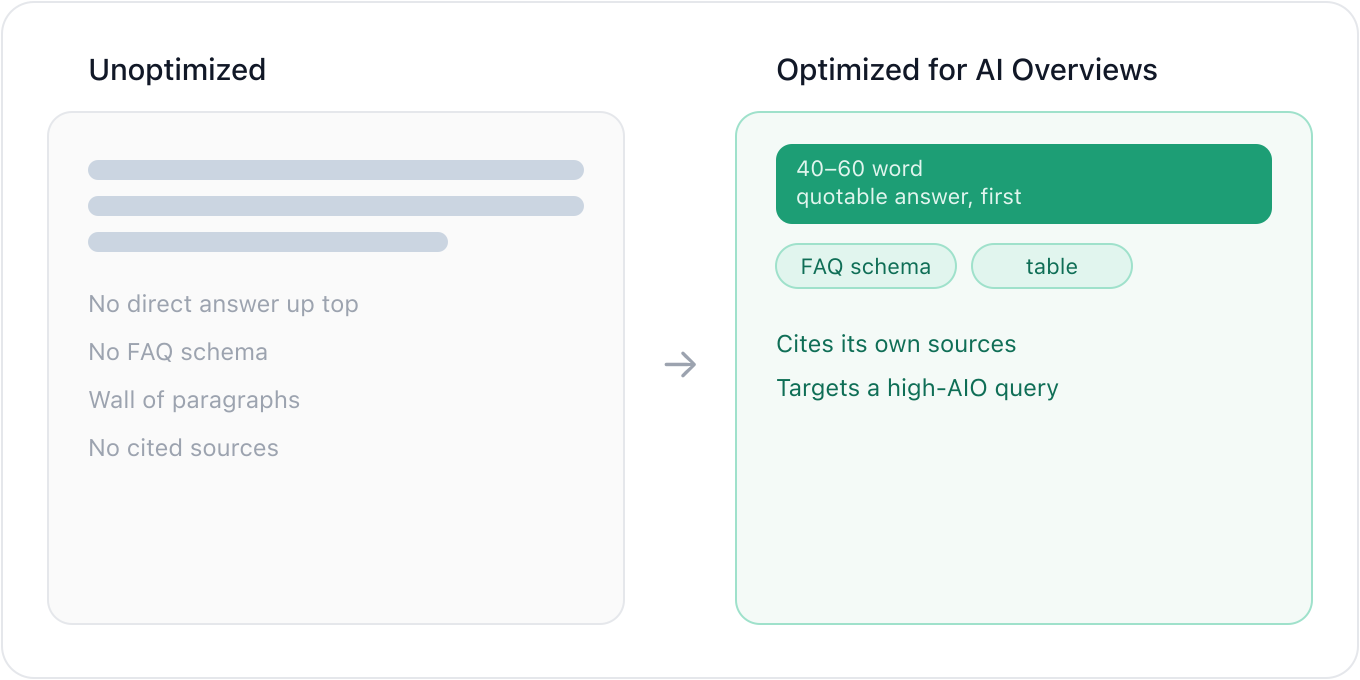
Being cited isn't luck. It's structure. Google's AI Overviews prioritize content that answers the query directly in the first 100 words, cites other sources, and formats data in tables or lists.
- Answer the query in the first 100 words. A self-contained, quotable answer, no fluff, before diving into details.
- Use FAQ schema to surface PAA-eligible questions.
- Cite authoritative sources. This signals you're a curator, not just an opinion.
- Format with tables and lists. AI Overviews extract structured data.
- Target high-AIO-prevalence queries. Health, finance, DIY, and travel are AIO goldmines.
When AIO Tracking Matters: By Industry
High-AIO Industries (Track Urgently)
Health & Medical: 60-75% AIO prevalence. Very high zero-click risk. Action: Urgent.
Finance & Investment: 55-70% AIO prevalence. High zero-click risk. Action: Start this quarter.
DIY & How-To: 50-65% AIO prevalence. High zero-click risk. Action: Start tracking now.
Travel & Hospitality: 45-60% AIO prevalence. Medium-high zero-click risk.
Low-AIO Industries (Monitor, Don't Panic)
Local Services: Under 5% AIO prevalence. Not urgent.
Branded Searches: Under 10% AIO prevalence. Monitor for reputation issues.
FAQ: AIO Tracking Questions Answered
What is AIO tracking?
AIO tracking monitors whether your brand is cited in Google AI Overviews. It measures visibility in synthesized AI answers, not just organic search rankings.
How often should I check my AIO visibility?
Weekly for most brands. Daily if you're in high-velocity niches (health, finance, trending topics).
Can I track AI Overviews for free?
Yes. Use Google Search Console (look for high-impression, low-click patterns) or GA4 (segment traffic from AIO queries). Manual monitoring via screenshots works for under 50 keywords.
What's the difference between AI Overviews and AI Mode?
AI Overviews appear in organic search results (free). AI Mode is Google's paid subscription alternative to ChatGPT. Track both.
Why should I track multiple AI models?
Because 30-40% of searchers also use ChatGPT or Perplexity for research. You're missing visibility if you only track Google.
Start Tracking Your AIO Visibility Today
Google's AI expansion isn't slowing. AI Overviews, AI Mode, ChatGPT, Perplexity, and Gemini are reshaping how people search. Zero-click rates are climbing. Traditional rank tracking is incomplete.
AIO tracking isn't optional anymore. It's essential.
Start here:
- This week: Set up Google Search Console filters and GA4 events to spot AIO-affected queries.
- This month: Track your citation and mention data for 20-30 important keywords.
- Next quarter: Expand to multi-engine tracking.
AllSearch makes this simple. Track all five engines (Google AI Overviews, AI Mode, ChatGPT, Perplexity, and Gemini) in one dashboard. See your geographic risk. Monitor sentiment. Benchmark against competitors.