Best AEO Tools for 2026
A hands-on comparison of the best AEO tools for 2026. See which answer engine optimization platforms track your AI citations, what they cost, and how to choose.

TL;DR: AEO tools track how often AI engines like ChatGPT, Perplexity, and Google AI Overviews cite your brand, and they show you how to get cited more. We rank AllSearch first because it shows the exact pages an engine pulls from, not just a visibility score. Profound and Semrush AI Visibility suit large teams, Otterly.ai and Peec AI fit smaller budgets, and most tools offer a free report or trial so you can test before you commit.
Answer engines now sit between your content and your customer. Someone asks ChatGPT or Google's AI Overview a question, reads the synthesized answer, and never clicks a blue link. If your brand is not in that answer, you are invisible for that query. Answer engine optimization tools exist to fix that. They measure your presence in AI answers, tell you which sources those answers trust, and point to the work that moves you into the citation.
This guide compares the best AEO tools for 2026, what each is best for, and how to choose.
AEO tools at a glance
| Tool | Best for | Engines tracked | Standout feature | Free option | Starting price |
|---|---|---|---|---|---|
| AllSearch | Source and citation tracking | 1 platform on Starter, 3 on Agency Pro (5 supported: ChatGPT, Perplexity, Gemini, Google AI Overviews, Google AI Mode) | See the exact pages AI cites, then draft content to win them | Free AI visibility report in under 60 seconds | $99/mo |
| Profound | Enterprise AI visibility | ChatGPT on Starter, up to 10+ engines on higher tiers | Deep enterprise analytics | Demo | $99/mo (Starter), $399/mo (Growth) |
| Semrush AI Visibility | Existing SEO teams | Multiple engines | AEO built into a full SEO suite | No free trial | $99/mo standalone, or Semrush One from $199/mo |
| Otterly.ai | Small teams and budgets | ChatGPT, Perplexity, Google AI Overviews (Gemini and AI Mode as add-ons) | Prompt and mention tracking at a low price | 14-day free trial | $29/mo |
| Peec AI | Agencies and reporting | 3 engines per plan, more via add-ons | Clean, shareable reports | Trial | €89/mo (~$95) |
| AthenaHQ | Guided AEO workflows | 8+ LLMs | Guided workflow, unlimited seats | First month ~$95 | $295/mo |
| Scrunch | Enterprise monitoring | 4 engines on Core, up to 9 on Enterprise | Large-scale monitoring with sentiment | Demo | $250/mo |
| Ahrefs Brand Radar | Existing Ahrefs users | Up to 6 AI platforms | AI mentions inside the Ahrefs toolset | Free during beta | Ahrefs Lite $129/mo plus AI indexes |
| Surfer AI Tracker | Content teams | ChatGPT on Standard, 5 engines on Pro | Tracking tied to content optimization | Trial | $99/mo |
| Writesonic GEO | Content and tracking in one | ChatGPT, Gemini, Google AI Overviews on Starter, 10+ higher up | AEO tracking plus AI writing | Trial | $79/mo |
What are AEO tools?
AEO tools are software that measures and improves how often AI answer engines cite your brand. They track your presence across engines like ChatGPT, Perplexity, Gemini, and Google AI Overviews, show which sources each answer trusts, and highlight the content and structure changes that get you cited.
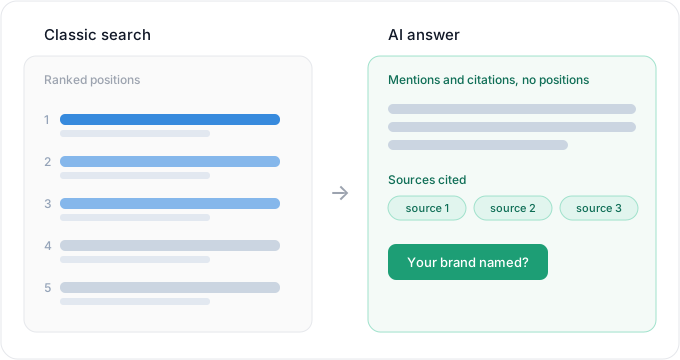
Traditional SEO tools optimize for ranked links on a results page. AEO tools optimize for a different surface: the synthesized answer an AI gives, where there is no list of ten blue links, only a handful of cited sources. The metrics change too. Instead of position and clicks, AEO tools measure citation rate, mention rate, share of voice across prompts, and sentiment.
What to look for in an AEO tool
Not every tool does the same job. Some only monitor. The useful ones connect monitoring to action. Weigh these criteria:
- Engine coverage. Confirm the tool tracks the engines your buyers actually use, not a generic "AI" label.
- Source and citation visibility. A score tells you that you are losing. Seeing the exact pages an engine cites tells you why, and what to build. This is the single most useful capability and the one tools vary on most.
- Prompt tracking. You want to follow the real questions your audience asks, not a fixed keyword list.
- Competitor benchmarking. Share of voice against named rivals turns a number into a target.
- Path to action. The best tools move from "here is the gap" to "here is the content that closes it."
- Price and team fit. Enterprise platforms bill for depth and scale. Smaller teams need a plan that does the core job without it.
How we picked
We prioritized tools that track real AI engines, expose the sources behind each answer, and connect that data to a next step. We favored transparency about what a tool measures over marketing claims, and we noted where pricing is public versus quote-only. AEO is young and moving fast, so treat every list, including this one, as a snapshot and verify current features before you buy.
The best AEO tools for 2026
1. AllSearch — best for source and citation tracking
AllSearch is an AI visibility tracker built around one idea: knowing your score is not enough, you need to see what the answer is made of. It tracks your brand across ChatGPT, Perplexity, Gemini, Google AI Overviews, and Google AI Mode, and gives you an AI Visibility Score from 0 to 100 benchmarked against your competitors.
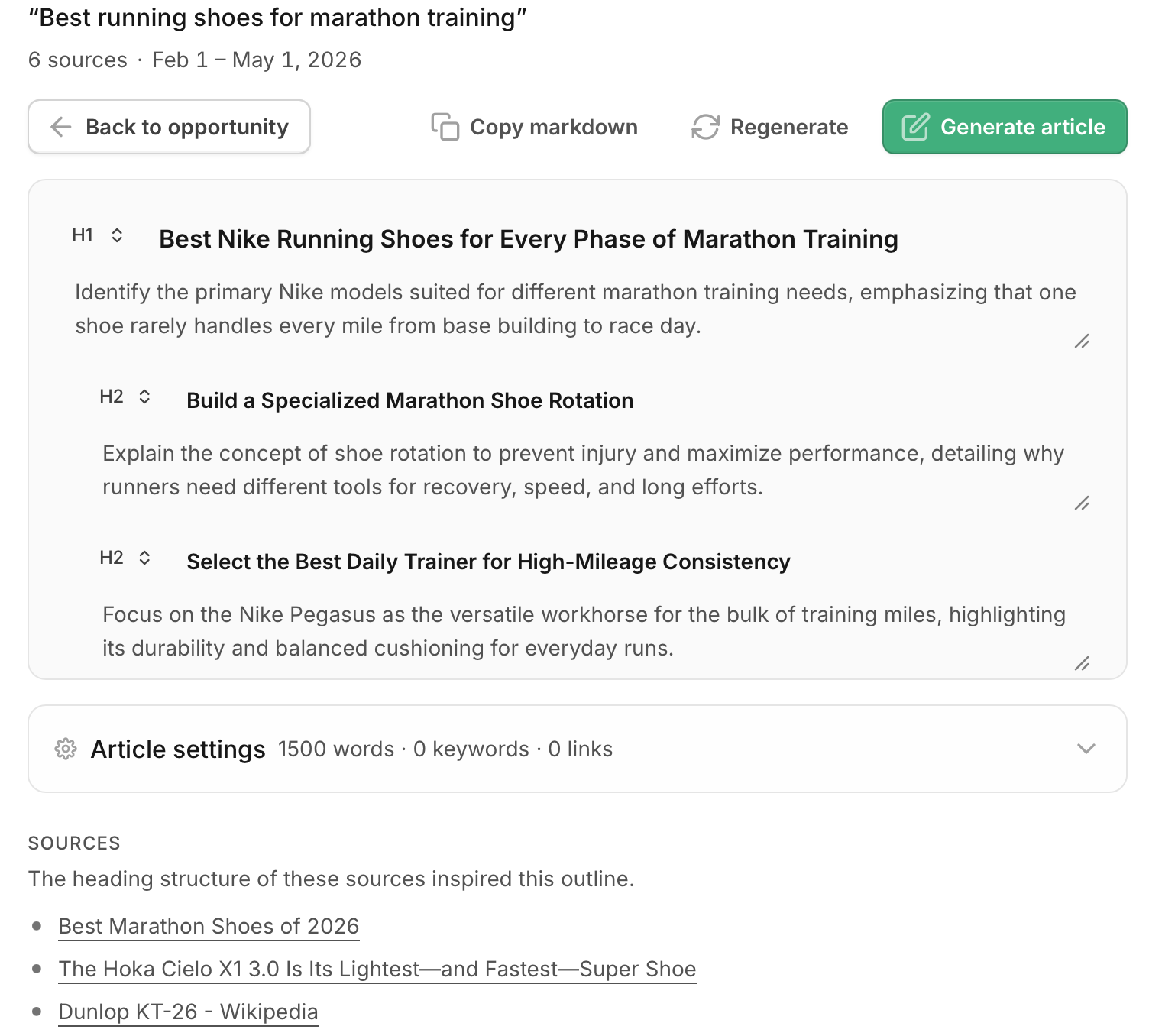
The difference is source and citation tracking. For each prompt, AllSearch shows the exact domains and URLs an engine pulled from, including the pages AI trusts but never links to in a way you would otherwise see. From there its AEO content strategy starts from the prompts you are losing, studies the sources the AI cites, and its AI content creation tool drafts a brand-tailored, publish-ready article in about a minute.
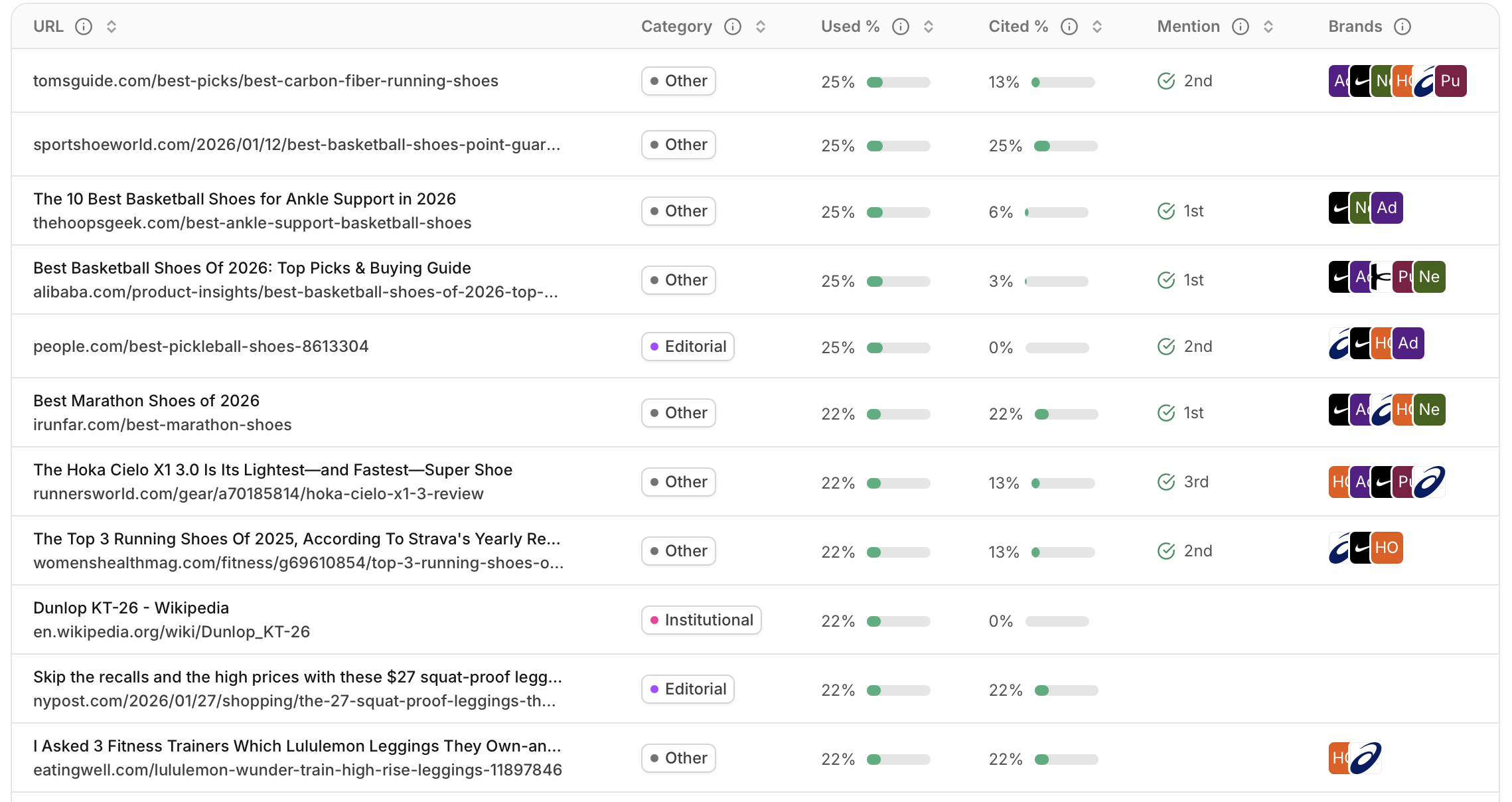
Most AEO tools stop at monitoring. They tell you that you are losing a prompt, then leave the fix to you. AllSearch includes the content step, with up to 10 AI-written articles a month on the $99 plan, so the same tool that finds the gap also drafts what closes it.
- Best for: teams who want to know why they are or are not cited, then act on it.
- Key features: AI Visibility Score, per-prompt source and citation tracking, prompt tracking, competitor benchmarking, content-gap analysis, share of voice, and built-in AI content creation with prioritized action lists.
- Pros: shows the exact cited sources, not just a score; moves straight from insight to drafted content; competitor benchmarking on every plan.
- Cons: newer platform with a shorter public track record than incumbents like Semrush or Ahrefs; the entry plan tracks one engine.
- Pricing: start a free trial (no card required) with a free AI visibility report in under 60 seconds after a short setup. Starter $99/mo (25 prompts, 1 AI platform, up to 5 competitors, 10 articles), Agency Pro $299/mo (100 prompts, 3 platforms, unlimited competitors, 30 articles), Enterprise custom.
2. Profound — best for enterprise AI visibility
Profound is aimed at large teams that need deep AI visibility analytics across many prompts, markets, and engines. Its Starter plan tracks ChatGPT only, and engine coverage widens as you move up, with the full suite (ChatGPT, Perplexity, Claude, Gemini, Grok, Copilot, Google AI Mode, and more) on Enterprise.
- Best for: enterprise teams with budget for depth and scale.
- Pros: strong analytics depth; broad engine coverage at the top tier; agency workspaces available.
- Cons: engine coverage is thin on the entry plan, and full coverage means Enterprise pricing.
- Pricing: Starter $99/mo (ChatGPT only), Growth $399/mo (adds Perplexity and AI Overviews), Enterprise custom.
3. Semrush AI Visibility — best for existing SEO teams
Semrush folds AI visibility into its established SEO suite, so teams already living in Semrush can add AEO without onboarding a separate tool. Its AI Visibility Toolkit tracks brand mentions and citations across the major engines.
- Best for: teams standardized on Semrush.
- Pros: one platform for SEO and AEO; familiar interface for existing users.
- Cons: the standalone toolkit covers one domain and 25 prompts at entry, and there is no free trial.
- Pricing: AI Visibility Toolkit $99/mo standalone, or the combined Semrush One from $199/mo.
4. Otterly.ai — best for small teams and budgets
Otterly.ai offers prompt and mention tracking at a price that suits solo marketers and small teams testing AEO for the first time.
- Best for: small teams testing AEO without a large spend.
- Pros: approachable entry price; 14-day free trial with no card required.
- Cons: lower tiers cap prompts (15 on Lite), and Gemini and Google AI Mode are paid add-ons rather than included.
- Pricing: Lite $29/mo, Standard $189/mo, Premium $489/mo.
5. Peec AI — best for agencies and reporting
Peec AI is often chosen by agencies for clean, shareable AI visibility reports across multiple clients, with dedicated agency plans and unlimited client seats.
- Best for: agencies reporting to clients.
- Pros: presentable reporting; multi-brand and multi-country tracking on higher tiers.
- Cons: each plan fixes engine coverage at three, so extra engines cost more; pricing is in euros.
- Pricing: Starter €89/mo (~$95), Pro €205/mo, Advanced €425/mo, plus agency plans.
6. AthenaHQ — best for guided AEO workflows
AthenaHQ pairs tracking with a guided optimization workflow, so the tool points to the next move rather than leaving you with raw numbers. It covers 8 or more LLMs and offers unlimited seats with role-based access on all plans.
- Best for: teams that want a guided, action-led process.
- Pros: action-oriented workflow; unlimited seats with RBAC is unusual at this price.
- Cons: the credit-based model can feel metered if you increase cadence or track more competitors.
- Pricing: Starter $295/mo (first month around $95 during promotions), Enterprise custom.
7. Scrunch — best for enterprise monitoring
Scrunch focuses on large-scale monitoring of brand presence, position, sentiment, citations, and share of voice across engines. Its Core plan covers four engines, scaling to nine on Enterprise.
- Best for: enterprises monitoring visibility at scale.
- Pros: breadth of monitoring, including sentiment and AI bot traffic.
- Cons: one of the higher entry prices in the category.
- Pricing: Core $250/mo, Growth $500/mo, Enterprise custom.
8. Ahrefs Brand Radar — best for existing Ahrefs users
Brand Radar brings AI mentions and citations into the Ahrefs toolset, so Ahrefs users can add an AEO view alongside their backlink and keyword data.
- Best for: teams already paying for Ahrefs.
- Pros: no new vendor to onboard; sits next to established SEO data.
- Cons: full AI tracking requires a base Ahrefs plan plus paid indexes, which pushes the all-in cost high once the beta ends.
- Pricing: Ahrefs Lite from $129/mo, with AI indexes at $199/mo each or $699/mo bundled (free during beta).
9. Surfer AI Tracker — best for content teams
Surfer ties AI visibility tracking to its content optimization workflow, which suits teams that write and optimize in one place.
- Best for: content teams already using Surfer.
- Pros: tracking sits next to content optimization; shows cited sources and how competitors are framed.
- Cons: the Standard plan tracks ChatGPT only; you need Pro for the full five-engine set.
- Pricing: Standard $99/mo (ChatGPT only), Pro $182/mo (5 engines), Peace of Mind $299/mo.
10. Writesonic GEO — best for content and tracking in one
Writesonic combines AEO and GEO tracking with AI writing, aimed at teams that want to measure and produce in a single tool.
- Best for: teams wanting tracking plus content generation.
- Pros: two jobs in one tool; broad engine coverage on higher tiers.
- Cons: the core GEO tracking features start on paid tiers, not the cheapest entry.
- Pricing: Starter $79/mo, Professional $249/mo, Growth $399/mo.
Free AEO tools worth a look
If you want a quick read before committing to a paid platform, several free options exist. HubSpot's AEO Grader gives a one-time brand check, and standalone utilities like aeotool.com and aeochecker.ai offer free scans. AllSearch also starts with a free AI visibility report in under 60 seconds after a short setup. Free tools are good for a first signal. For ongoing tracking and action, a paid platform does more.
How to choose the right AEO tool
- You want to know why you are not cited, then fix it: most tools only monitor. Choose one that pairs real source and citation tracking with built-in content creation, like AllSearch, so tracking and the fix live in one plan.
- You are an enterprise with scale and budget: look at Profound or Scrunch.
- You already pay for an SEO suite: add Semrush AI Visibility or Ahrefs Brand Radar before buying a separate tool.
- You are a small team or solo marketer: start with Otterly.ai or a free report.
- You are an agency reporting to clients: weigh Peec AI for its reporting.
Match the tool to the job. A monitoring-only tool tells you the weather. A tool that shows sources and drafts content helps you change it.
AEO vs SEO, and AEO vs GEO
AEO vs SEO: SEO earns ranked links on a results page. AEO earns citations inside an AI-generated answer. They share fundamentals like useful content and clean structure, but the target and the metrics differ. AEO does not replace SEO. It sits next to it as AI answers take more of the journey.
AEO vs GEO: the terms overlap. AEO (answer engine optimization) and GEO (generative engine optimization) both describe getting your brand into AI answers. Most tools use them interchangeably. Pick the tool by what it does, not by which acronym it prints.
FAQs
What are AEO tools?
AEO tools are software that measures and improves how often AI answer engines cite your brand. They track your visibility across engines like ChatGPT, Perplexity, Gemini, and Google AI Overviews, show which sources each answer trusts, and point to the changes that get you cited.
How are AEO tools different from SEO tools?
SEO tools optimize for ranked links and measure position and clicks. AEO tools optimize for citations inside AI answers and measure citation rate, mention rate, and share of voice across prompts. Many teams use both.
What is the difference between AEO and GEO?
Very little. Answer engine optimization and generative engine optimization both mean getting cited in AI-generated answers, and most tools treat the terms as synonyms. Choose a tool by its features, not its label.
How much do AEO tools cost?
Pricing ranges from free reports and low-cost plans for small teams to quote-only enterprise contracts. Several tools offer a free tier or trial so you can test before you buy. Confirm current pricing on each vendor's site.
Do I need a dedicated AEO tool, or can my SEO platform handle it?
If you already use a suite like Semrush or Ahrefs, start with its AI visibility features. If you need deeper source and citation detail or a direct path from insight to content, a dedicated AEO tool will do more.
How do I know if my content is being cited in AI answers?
An AEO tool tracks your brand across engines and reports when and where you are cited, including the exact sources an answer pulls from. AllSearch, for example, shows the specific pages behind each answer so you can see what to build.
How long until I see results from AEO?
It varies by engine, competition, and how much you publish. Answer engines refresh at different speeds, so expect weeks rather than days. Tracking from the start lets you see movement as it happens.