
Ecommerce GEO: how to optimize your store for AI search

TL;DR
E-commerce GEO (generative engine optimization) is the work of getting your products and category pages named and cited when people shop through AI answers on ChatGPT, Perplexity, Google AI Overviews, and Google AI Mode. It matters more for ecommerce than for most sectors because organic search is the cheapest layer of your acquisition stack, and AI answers erode that layer first. The practical move is not to optimize your whole catalog at once. Start with the categories and products that drive the most revenue and depend most on organic traffic, build content around the real questions buyers ask about them, and measure whether AI engines start citing you.
E-commerce marketing is evolving: what dozens of interviews taught me
Over the last six months I interviewed dozens of marketers on how SEO teams are changing the way they work to cope with the shift from SEO to GEO. Three things came up again and again:
- Quality is beating volume, every time. A handful of well-optimized pages beat a pile of average or AI-slop pages.
- Revenue-first prioritization is already how the best teams think, most just haven't made it explicit.
- Measurement is the recurring frustration: data spread across too many tools, no single view of what matters.
What ecommerce GEO is
Ecommerce generative engine optimization is the practice of structuring your product data, category pages, and content so that AI engines cite your store when they answer shopping questions. Instead of competing only for a ranked position in a list of links, you are competing to be named inside the generated answer and to be one of the sources the engine pulls from to build it.
Classic SEO earns a spot in a list a shopper scrolls. GEO earns a mention in an answer a shopper reads. Answer engine optimization (AEO) aims at direct-answer formats specifically; for a store, the two overlap almost entirely, so this guide treats them together and uses GEO throughout.
How AI engines decide which stores to cite
An AI shopping answer is assembled, not ranked. The engine pulls from sources it can read and trust, then writes a synthesis that names a handful of products and brands. Three things decide whether you are in that synthesis:
- Can the engine read your product data. Structured data, clean feeds, and machine-readable pages.
- Does the engine trust the source. Independent reviews and consistent information raise the odds.
- Does your content answer the actual question. Real detail gets cited more than a thin listing.

Why e-commerce brands need GEO now
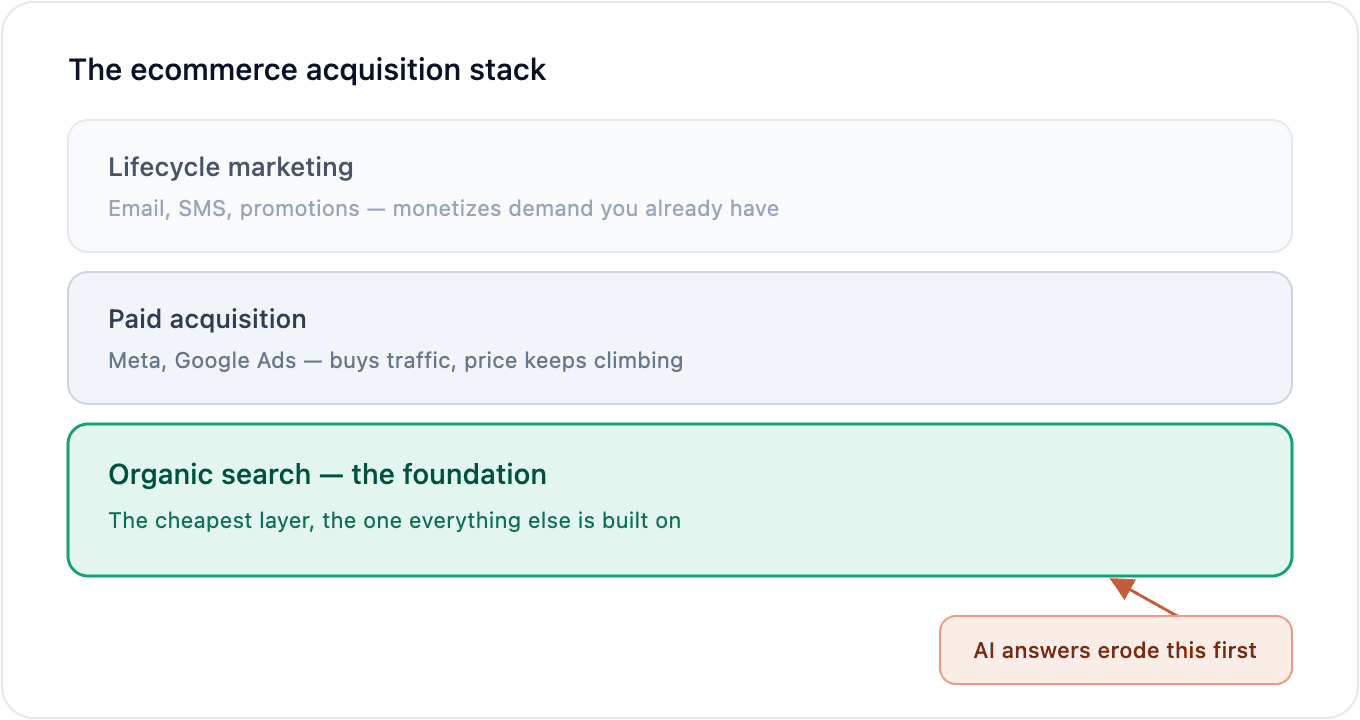
E-commerce margins are squeezed from every direction at once: cost of goods, fulfillment, returns, platform fees, rising CAC. Organic search sits at the bottom of the acquisition stack as the foundation, the channel with the best unit economics. Paid acquisition sits above it, effective but costing more every year. Lifecycle marketing is the most efficient layer of all, but it monetizes demand you already captured, it does not create new demand the way organic does.
When a shopper gets a full answer inside an AI engine and never clicks through, the layer that loses that visit first is organic, the cheapest one. Holding traffic then means buying it back through paid, the most expensive lever, right when margins can least absorb it.
Your cheapest channel is the one most exposed to AI answers, and replacing it is the priciest thing you can do.
The e-commerce acquisition stackLifecycle marketingEmail, SMS, promotions, monetizes demand you already havePaid acquisitionMeta, Google Ads, buys traffic, price keeps climbingOrganic search, the foundationThe cheapest layer, the one everything else is built onAI answers erode this first
Quality beats volume, and it is not close
This is the finding that came up in almost every interview, and it runs against how most content operations still work. A few genuinely high-quality pages beat a large pile of average ones, not by a little. AI engines learn to skip thin, near-duplicate, mass-produced content, and publishing more of it dilutes the pages that were actually good.
If you take one operating principle from this guide: do not scale AI slop, concentrate effort on the pages that matter and make them undeniable.
Where to start: prioritize by revenue and organic dependency
Rank categories on two axes: revenue contribution over the last 12 months, and organic dependency, the share of that category's traffic coming from organic rather than paid or lifecycle. Start where both are high.
| Category | Revenue | Organic | Priority |
|---|---|---|---|
| A | $2.0M | 70% | Start here |
| B | $5.0M | 20% | Lower |
| C | $0.8M | 85% | Medium-high |
Category B earns more but is mostly paid-driven, so it can absorb organic loss cheaply. Category A has more to lose and nowhere cheaper to turn. It goes first.
The building blocks of e-commerce GEO
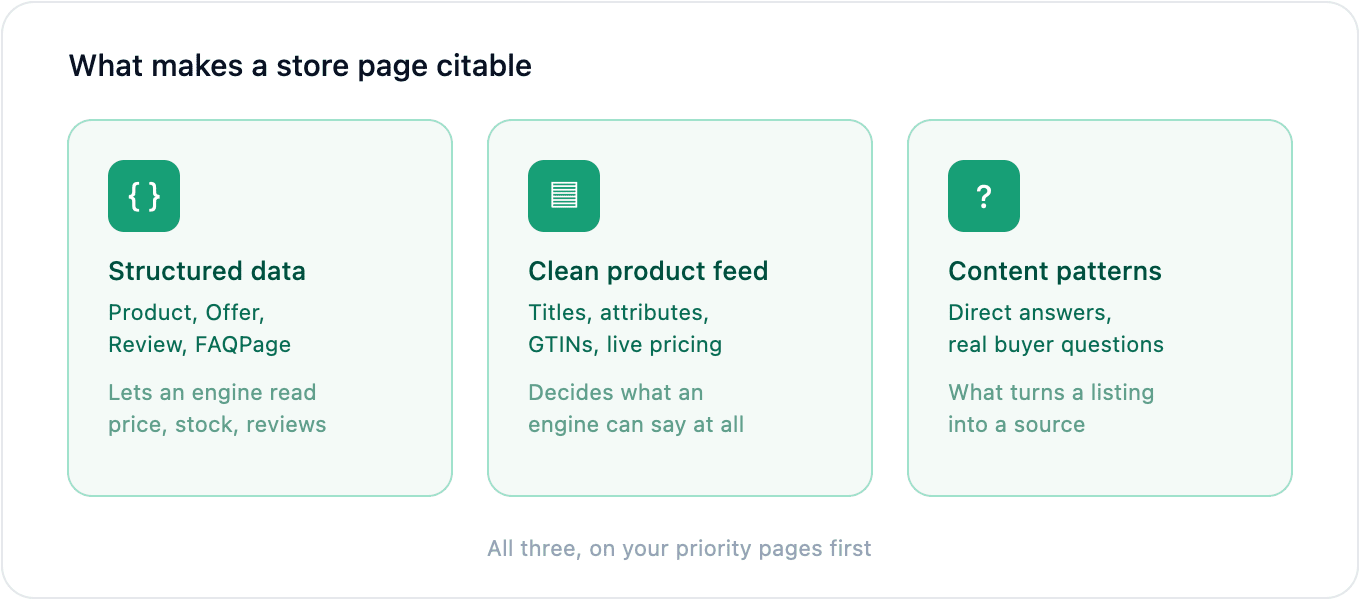
For prioritized categories, three things do most of the work: structured data (Product, Offer, Review, FAQPage schema), a clean product feed, and content patterns that directly answer real buyer questions.
Trust is earned off your own site too
AI engines weight independent consensus heavily. Reviews on independent platforms, genuine community presence, and consistent core facts across every surface you control all raise the odds an engine treats your data as reliable.
How to measure e-commerce GEO performance
Classic rank tracking cannot see AI answers. A tool can report position four while an AI Overview answers the same query above you, cites three competitors, and never mentions you. What you track instead: mention, citation and source, share of voice, and movement over time.
What is next: agentic commerce
The direction of travel is AI agents that do not just recommend a product but buy it. The groundwork is the same work described above: clean structured data, an accurate feed, and machine-readable pages.
See where you stand. Get a free AI visibility report in under 60 seconds after a short setup.
Frequently asked questions
What is e-commerce GEO?
E-commerce GEO (generative engine optimization) is the practice of structuring your product data, category pages, and content so AI engines cite your store when they answer shopping questions. Instead of competing only for a ranked position in a list of links, you compete to be named inside the generated answer and to be one of the sources the engine pulls from.
What is the difference between GEO, AEO, and SEO for e-commerce?
SEO earns your pages a position in a ranked list of links. GEO earns your products a mention and citation inside an AI-generated answer. AEO (answer engine optimization) is the same idea aimed at direct-answer formats specifically. For a store, GEO and AEO overlap almost entirely, so most teams treat them as one effort.
Is GEO replacing SEO?
No. GEO extends SEO, it does not replace it. Classic rankings still drive a large share of ecommerce traffic, and most GEO work is good SEO practice pointed at a new surface. The change is that you now also need to track and earn presence inside AI answers, not just positions.
Is SEO dead or evolving in 2026?
Evolving. Search is splitting into two surfaces: the classic ranked list and the AI-generated answer. Both send traffic and both matter. What is fading is the assumption that a ranked position is the only way to be found. Stores now need to be visible in both places.
What schema markup does e-commerce GEO require?
Start with Product and Offer schema so engines can read price, availability, and attributes, then add Review schema and a FAQPage block on your priority pages. Review markup and a genuine FAQ give an engine rich, specific data to cite, which thin product pages do not provide.
How do you measure GEO performance for an online store?
You track whether AI engines mention and cite you, not just where you rank. The core metrics are mention, citation and source, and share of voice against competitors, tracked over time across ChatGPT, Perplexity, Gemini, Google AI Overviews, and Google AI Mode. An AI visibility tracker runs your prompts on a schedule and records all of this.
What is the best reporting tool for e-commerce GEO?
The right tool depends on your stack, but it should run your real shopping prompts across the AI engines your buyers use, show the exact sources each answer cites, and benchmark your share of voice against competitors over time. AllSearch does this and gives you a free AI visibility report in under 60 seconds after a short setup.