What Is AI Visibility? A Clear Guide for 2026
AI visibility is how often AI engines like ChatGPT, Perplexity, and Google AI Overviews name and cite your brand. Here is what it means, how to measure it, and how to improve it.


TL;DR: AI visibility is how often, and how prominently, AI engines like ChatGPT, Perplexity, Gemini, and Google AI Overviews name and cite your brand when people ask about your space. It is the AI-answer version of "do we show up in search," except there is no ranked list of ten links, just an answer that mentions a few brands and cites a few sources. You measure it by tracking those mentions, citations, and your share of voice against competitors, then improve it by becoming one of the sources the engines trust.
AI visibility is the measure of how often and how prominently AI engines name and cite your brand in their answers. Instead of a ranking position, it tracks whether ChatGPT, Perplexity, Gemini, and Google AI Overviews mention you when someone asks about your space, which sources they pull from, and how your presence compares to competitors.
What AI visibility is, in plain terms
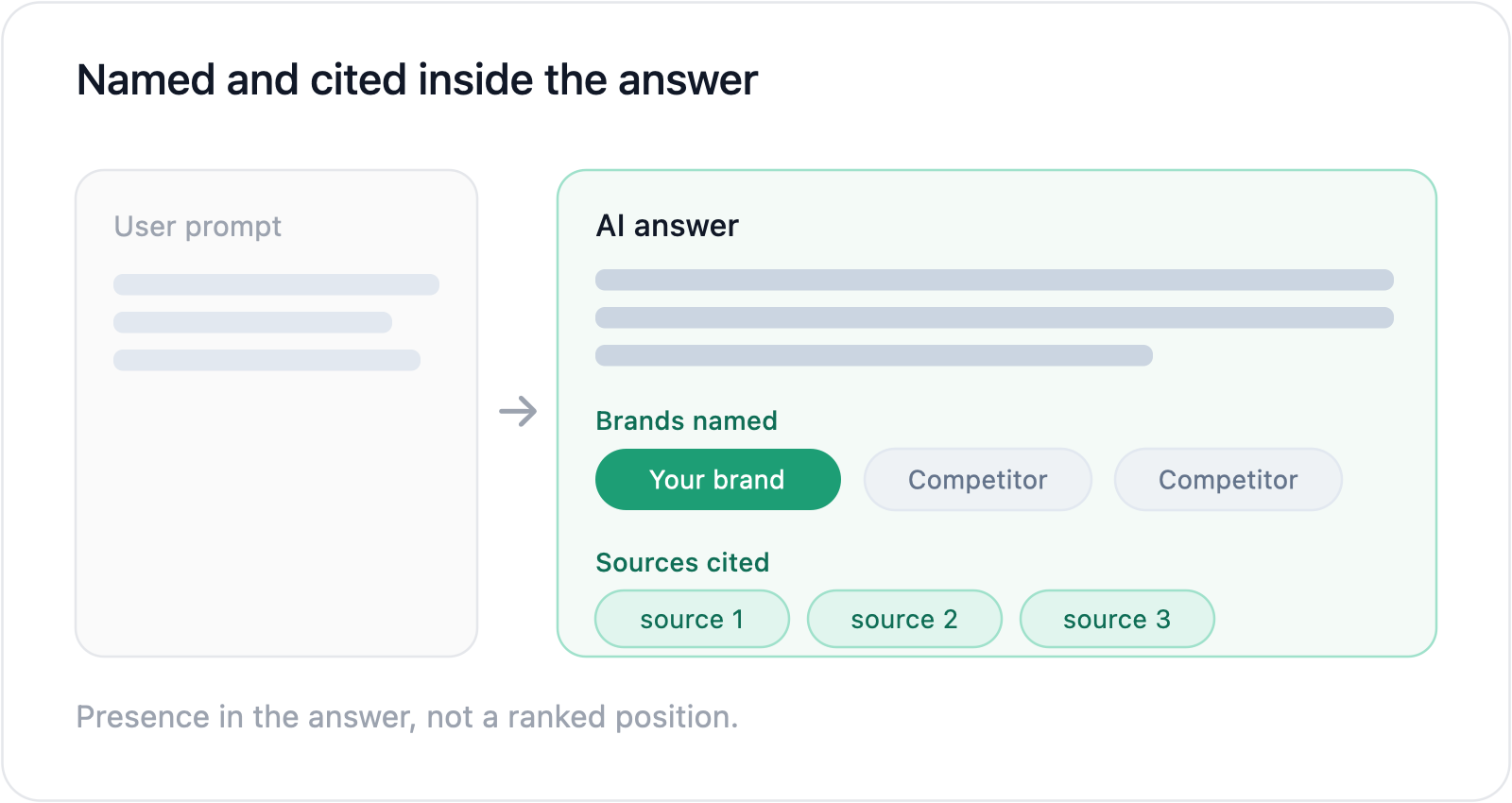
When someone asks an AI engine a question, they do not get a list of ten links to choose from. They get one answer, written on the spot, that names a few brands and cites a few sources. AI visibility is whether your brand is one of those named and cited, and how consistently.
That makes it different from a ranking. There is no "position four" inside a ChatGPT answer. You are either in the answer or you are not, and if you are, the useful questions are how prominently you appear, in what context, and which of your pages the engine trusted enough to cite. This is what people mean by AI brand visibility or AI search visibility: presence inside the answer, not a spot on a results page.
AI visibility vs traditional SEO visibility
The two answer different questions, and the difference is the whole point.
| Traditional SEO visibility | AI visibility | |
|---|---|---|
| The unit | A ranking position (1 to 10) for a keyword | A mention or citation inside a generated answer |
| The question | "Where do I rank for this keyword?" | "Am I named and cited when someone asks about my space?" |
| The result page | An ordered list of blue links | One synthesized answer citing a few sources |
| Where it happens | Google, Bing organic results | ChatGPT, Perplexity, Gemini, Google AI Overviews, Google AI Mode |
| What wins it | Rankings, backlinks, on-page SEO | Being a trusted, quotable, well-structured source the model cites |
Classic SEO still matters, and the two overlap: the pages that rank well in Google are often the same pages AI engines cite, because they share quality signals. But a good ranking no longer guarantees you show up. An AI Overview can answer a query above your position-three link, cite three competitors, and never mention you. Your rank looks fine. Your AI visibility is zero.
Why AI visibility matters in 2026
Search is moving from a list of links to a single answer. When the answer names three brands and cites three sources, the brands left out are invisible for that query, no matter how well they rank in the classic list.
- The click is disappearing. More searches end inside the AI answer with no click to any site. If the answer does not name you, you are not in the consideration set, and you never had the chance to be clicked.
- A citation transfers trust. Being cited inside an AI answer reads as an endorsement from the engine, not just a link the user has to evaluate. That is worth more than a position on a page most people now scroll past.
- Your competitors are already being named. For most commercial topics, some brands already show up in AI answers and others do not. The gap compounds: engines lean on sources they have cited before.
- It is early. Most companies are not tracking this yet. The brands that measure and act now shape which sources the engines learn to trust before the space gets crowded.
How AI engines decide what to cite
You cannot improve AI visibility without knowing what the engines reward. The signals are consistent across platforms, and they overlap heavily with good SEO.
- Source authority. Domain reputation, author expertise, and factual accuracy. Engines lean on sources they can treat as reliable.
- Answer-first structure. Content that states the answer clearly and early, in self-contained sections, is easier for a model to lift and cite than an answer buried under a long wind-up.
- Quotable, factual density. Specific facts, definitions, numbers, and comparisons get cited more than vague prose. A clean 40-to-60-word definition is exactly the kind of block an AI Overview pulls.
- Structured formats. FAQ blocks, comparison tables, and step-by-step lists map cleanly onto how engines assemble answers.
- Third-party signals. Being named in "best" lists, reviews, and reputable coverage tells the engine that others already treat you as an answer to this question.
- Freshness. Recently updated content is favored for topics that move, which most commercial topics do.
The through-line: engines cite sources that are authoritative, clearly structured, and easy to quote. That is also a fair description of good content, which is why AI visibility rewards the same discipline as SEO, aimed at a new surface.
How to measure AI visibility
You measure AI visibility the way you measure anything in search: run the queries your buyers actually ask, on a schedule, and record what comes back. Because there is no ranking, you track a small set of answer-level metrics instead.
- Mentions. How often an engine names your brand across the prompts you track. The baseline signal: are you in the answer at all.
- Citations and sources. Which exact domains and URLs the engine pulled from to build the answer. This is the most actionable metric, because it tells you what content earns a place in the answer, not just whether you made it.
- Share of voice. How often you appear versus competitors across the same set of prompts. Presence is relative; share of voice makes it a number.
- Sentiment. The context you are named in, positive, neutral, or negative, where the engine's framing can be assessed.
- Prompt or query coverage. The share of the prompts that matter to your business where you appear at all, so you can see the gaps as well as the wins.
- Movement over time. The same trend view SEO gives you, applied to AI answers, so a single reading becomes a direction.
What is an AI visibility score?
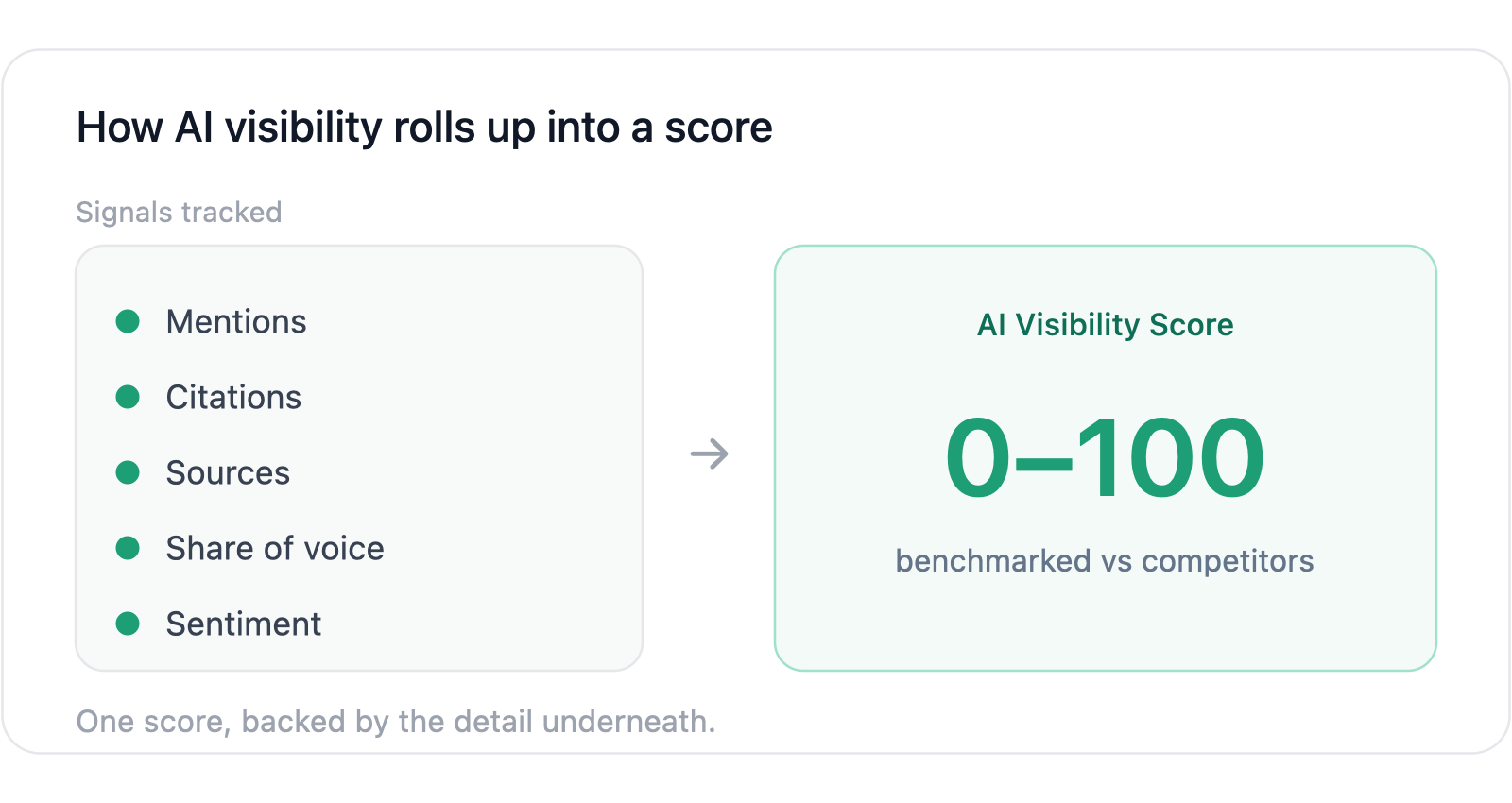
Most tools roll these signals up into a single AI visibility score, usually on a 0-to-100 scale, so you can see overall direction in one number instead of reading every prompt row. A score is a summary, not the whole story: it is only as good as the prompts behind it and it means the most when it is benchmarked against competitors on the same prompt set. Treat the score as the headline and the mention, citation, and source detail underneath it as the part you actually act on.
How to improve your AI visibility
Improving AI visibility is not a separate discipline from good marketing. It is the same work, pointed at the prompts you are losing and the sources the engines cite.
- Find the prompts you are losing. Start from the questions your buyers ask where a competitor is named and you are not. That is your target list.
- Study the sources the engine cites. For each of those prompts, look at which pages the engine actually pulled from. That tells you what kind of content earns the citation.
- Publish answer-first, quotable content. Lead with the answer, keep sections self-contained, add facts and comparisons, and structure with clear headings, FAQ blocks, and tables.
- Build third-party authority. Get named in "best" lists, reviews, and reputable coverage. Engines trust sources that others already treat as answers.
- Keep it fresh and let the engines in. Update the pages that matter, and make sure your content is technically accessible to the AI crawlers so it can be read and cited.
- Measure, then repeat. Re-run the prompts, watch whether your mentions and citations move, and feed the winners back into the next round.
AI visibility vs GEO vs AEO
These terms travel together and get used loosely, so here is the plain version.
- AI visibility is the outcome: how often and how prominently AI engines name and cite you. It is the thing you measure.
- AEO (answer engine optimization) and GEO (generative engine optimization) are the practice: the work you do to earn that visibility, the AI-answer counterpart to SEO.
In short, you do AEO or GEO in order to improve your AI visibility, the same way you do SEO to improve your rankings. Different label, same relationship between the work and the result.
How AllSearch tracks AI visibility
Tracking AI visibility works on the same principle as rank tracking: run your prompts on a schedule and record the result. The difference is what you record. Instead of a position, you watch presence, citations, and share of voice. This is what an AI visibility tracker does.
AllSearch tracks this across ChatGPT, Perplexity, Gemini, Google AI Overviews, and Google AI Mode, gives you an AI Visibility Score benchmarked against competitors, and, the part most tools skip, shows the exact sources AI cites for every tracked prompt, not just a yes or no. Everyone lists "citations" as a metric. Seeing the specific pages behind each answer is what turns the metric into a to-do list.
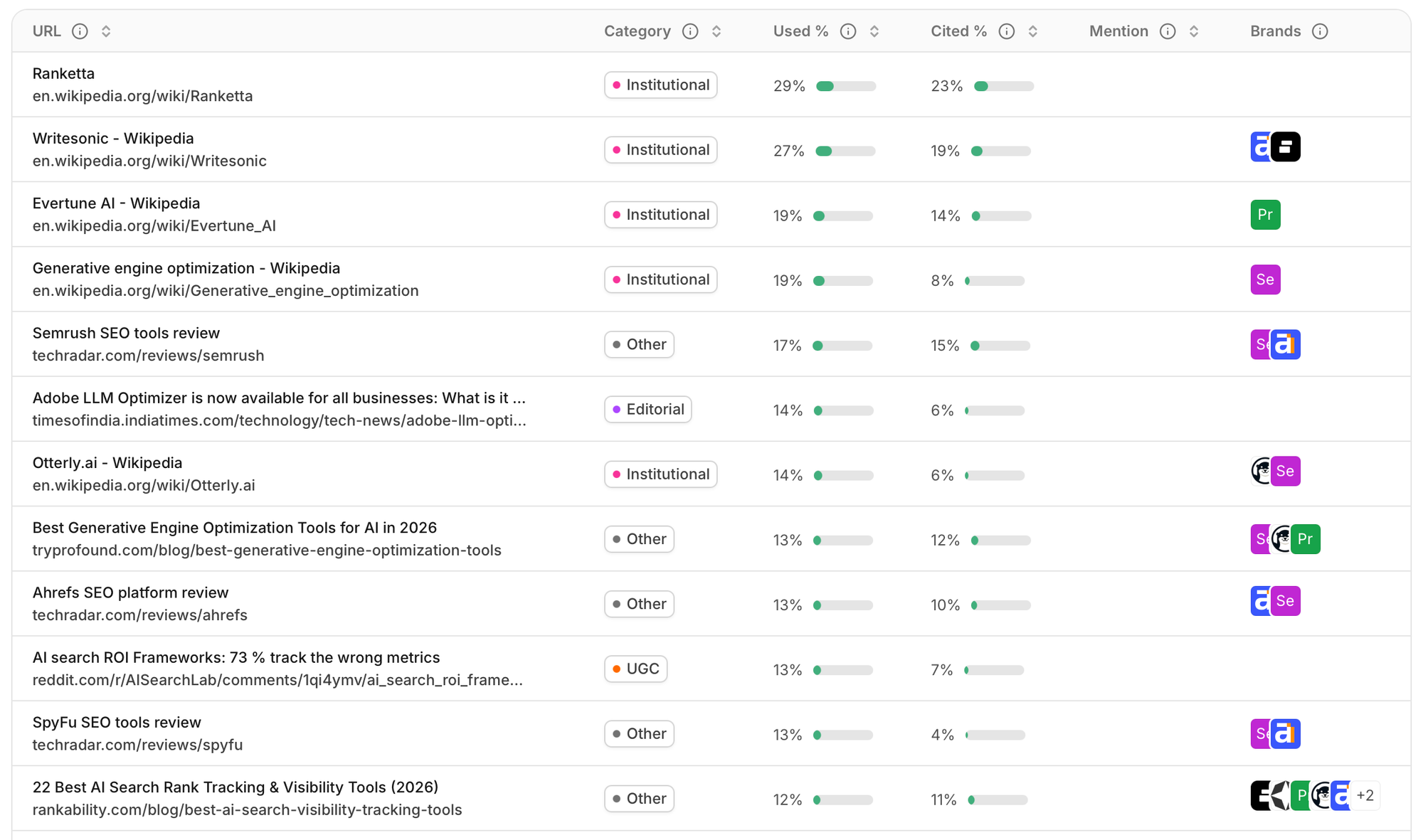
From there the work mirrors classic SEO: find the prompts you are losing, study the sources the engine cites, and close the gap with an AEO content strategy so you become one of the sources it trusts.
The bottom line
AI visibility is the new "do we show up." The search still happens, the answer still names a few brands, and being one of them is the whole game. The brands that measure it now, and act on which sources the engines cite, are the ones the engines will keep citing.
See where you stand. Get a free AI visibility report in under 60 seconds after a short setup, no guesswork about whether ChatGPT and Google AI Overviews mention you. Start your free AI visibility report.
Frequently asked questions
What is AI visibility?
AI visibility is the measure of how often and how prominently AI engines name and cite your brand in their answers. Instead of a ranking position, it tracks whether ChatGPT, Perplexity, Gemini, and Google AI Overviews mention you when someone asks about your space, which sources they pull from, and how your presence compares to competitors.
What does AI visibility mean, in simple terms?
It means whether AI engines mention your brand when people ask them about your space, and how often. There is no list of ten links inside an AI answer, so instead of a ranking you have presence: you are either named and cited, or you are not.
What is AI search visibility?
AI search visibility is the same idea as AI visibility, framed around AI-powered search specifically: how often you appear in Google AI Overviews, Google AI Mode, and answer engines like Perplexity when someone searches your topic. It measures presence in the generated answer rather than a position in the blue-link list.
How is AI visibility different from SEO?
Traditional SEO visibility is a ranking position for a keyword. AI visibility is a mention or citation inside a generated answer. They overlap, because pages that rank well are often the ones AI engines cite, but a good ranking no longer guarantees you appear. An AI answer can cite competitors and never name you while your classic rank looks fine.
What is an AI visibility score?
An AI visibility score rolls your mentions, citations, and share of voice into a single number, usually on a 0-to-100 scale, so you can track overall direction at a glance. It is most useful when it is benchmarked against competitors on the same set of prompts, with the mention and source detail underneath it as the part you act on.
How do you measure AI visibility?
You run the prompts your buyers ask, on a schedule, and record what the engines return: how often you are mentioned, which sources they cite, your share of voice against competitors, the sentiment of the mention, and how many of your target prompts you appear in at all. Tracked over time, those readings become a trend.
How do you improve AI visibility?
Find the prompts where competitors are named and you are not, study the sources the engine cites for them, and publish answer-first, quotable content that is structured with clear headings, FAQs, and tables. Build third-party authority, keep content fresh, let the AI crawlers in, then re-run the prompts and repeat.
Is AI visibility the same as GEO or AEO?
No. AI visibility is the outcome you measure: how often engines name and cite you. GEO (generative engine optimization) and AEO (answer engine optimization) are the practice you do to earn it. You do AEO or GEO to improve your AI visibility, the same way you do SEO to improve rankings.
Which AI engines should you track for visibility?
Track where your buyers actually ask: ChatGPT and Perplexity drive much of the AI-answer behavior today, alongside Gemini and Google AI Overviews. Google AI Mode is newer and lower volume, but worth watching as it grows. The right set is the engines your audience uses for your topic.
Can you check your AI visibility for free?
You can spot-check manually by asking a few engines your key prompts and noting whether they mention you, though results vary run to run. For a consistent read, AllSearch generates a free AI visibility report in under 60 seconds after a short setup, showing whether AI engines mention and cite you.