What is rank tracking and how it works


TL;DR
Rank tracking is how you monitor where your pages show up in search results for the keywords you care about, and how those positions move over time. It is the core feedback loop of SEO: it tells you whether your work is paying off. The catch in 2026 is that "a position" no longer covers the whole search. AI Overviews, ChatGPT, Perplexity, and Google AI Mode answer questions without a ranked list of links, so tracking is expanding from rank position to whether you are named and cited in the answer.
Rank tracking is the practice of monitoring your website's position in search engine results for a set of target keywords, and watching how those positions change over time. A rank tracker checks the search results on a schedule, records where each tracked page appears, and shows the movement so you can see whether your SEO work is improving visibility, holding steady, or slipping.
What rank tracking is, in plain terms
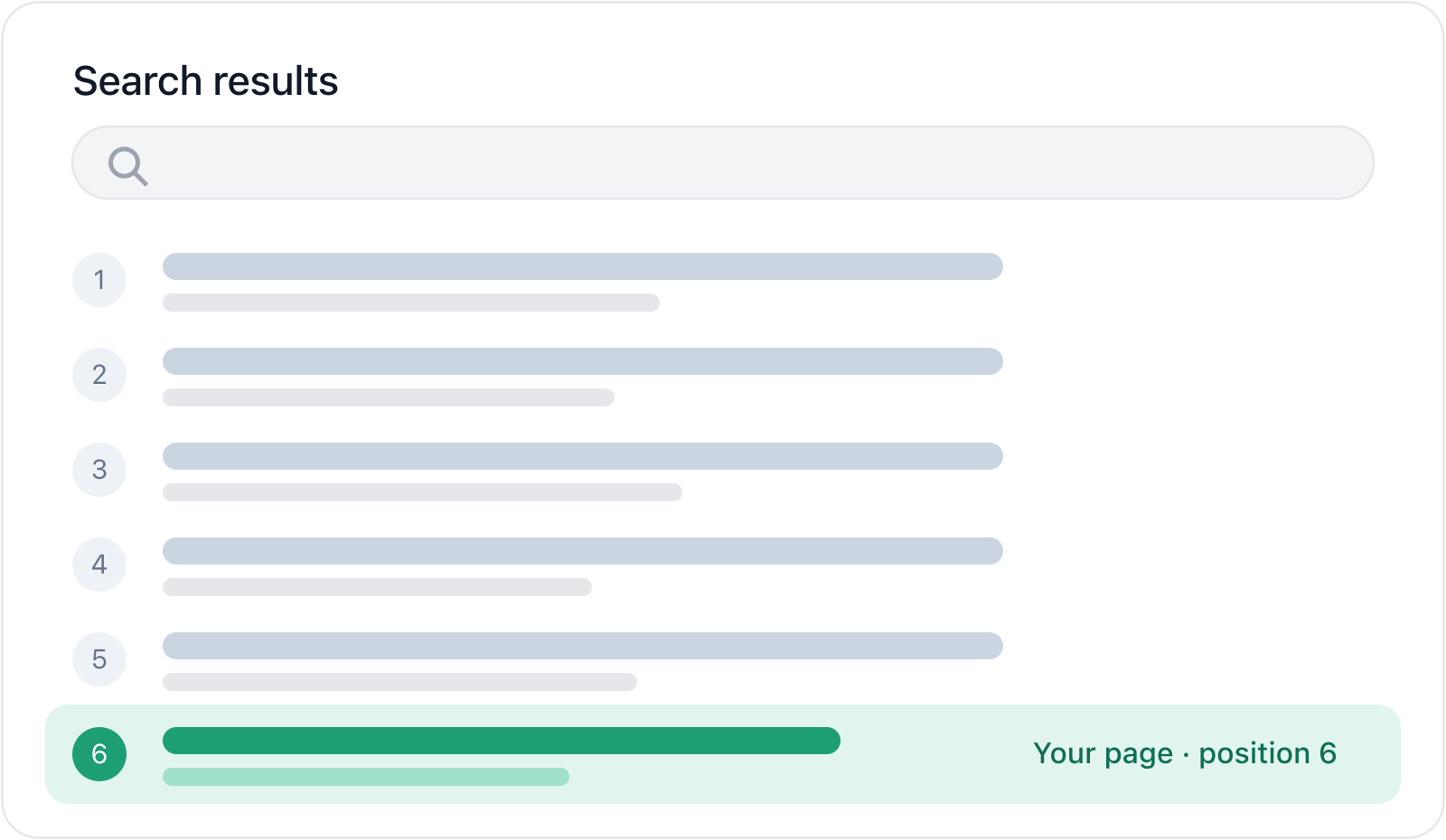
Every time someone searches, a search engine returns an ordered list of results. Your position in that list for a given keyword is your rank. Rank tracking is simply recording that position, on a schedule, for the keywords that matter to your business, so the number becomes a trend instead of a one-off guess.
A rank tracker is the tool that does this automatically. Instead of typing a query into Google yourself and scrolling to find your page (slow, and skewed by your own location and search history), the tool checks the results from a clean, location-specific vantage point and logs the position for you. Track ten keywords or ten thousand, the job is the same: turn "I think we rank okay" into "here is exactly where we rank, and here is which way it is moving.
Why rank tracking matters for SEO
SEO is a slow loop. You publish a page, improve it, build links, fix technical issues, and then wait to see if any of it worked. Rank tracking is how you close that loop with evidence instead of opinion.
It matters because it tells you:
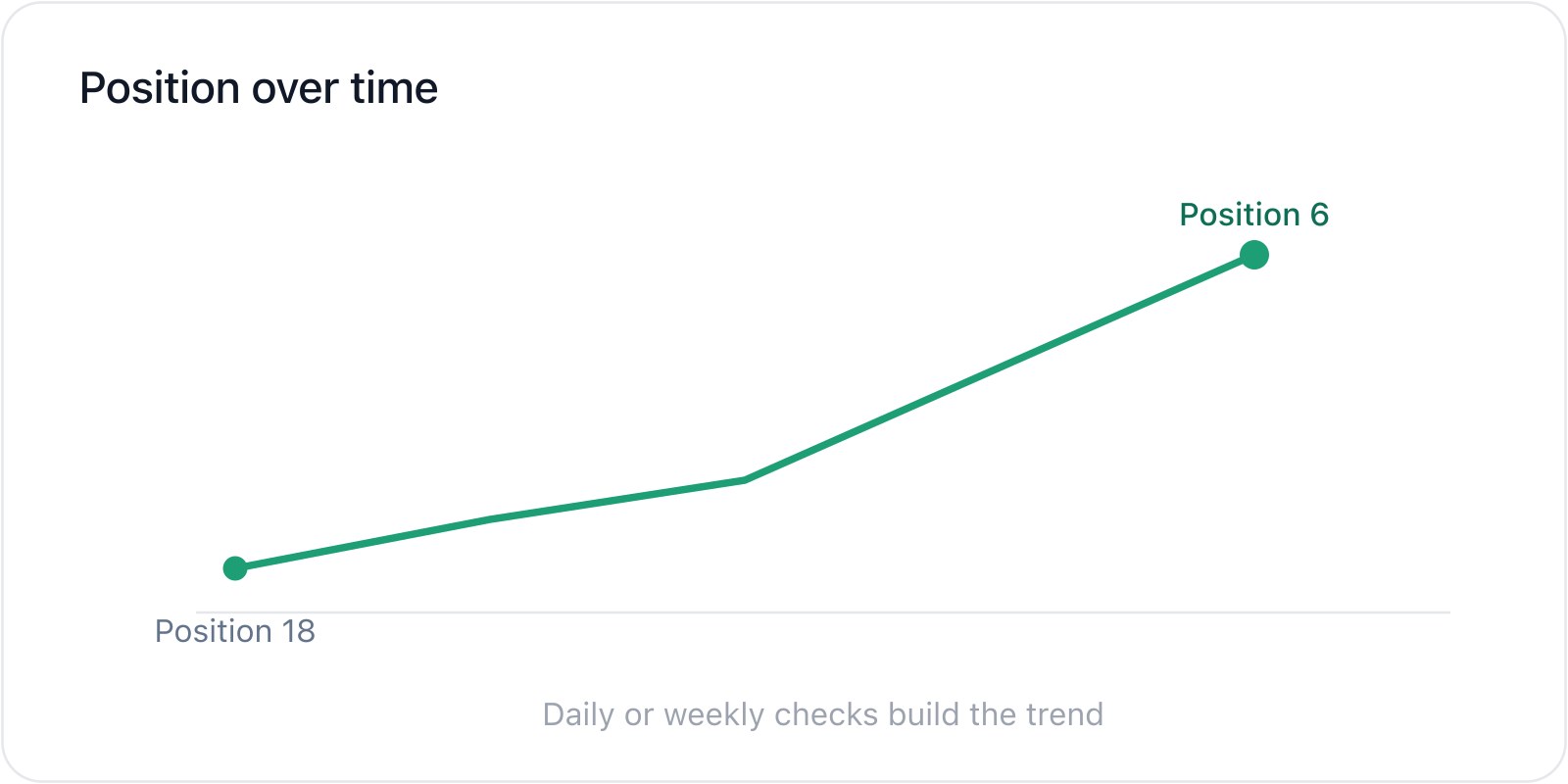
- Whether your work is paying off. A page climbing from position 18 to position 6 is proof the changes landed. A flat line tells you to try something else.
- Where the easy wins are. Keywords sitting on page two (positions 11 to 20) are often one round of work away from page one, where almost all the clicks are.
- When something breaks. A sudden drop across many keywords is an early warning of a penalty, a technical problem, or an algorithm update, often before traffic reports catch up.
- How you compare to competitors. Tracking rivals on the same keywords shows who is gaining ground and on which terms.
Without tracking, you are optimizing blind. With it, every decision has a before and after.
How rank tracking works
Most people picture a tool that "checks Google for you," and that is the right instinct. Underneath, a rank tracker does four things on a repeating schedule.
- It runs your keywords as searches. The tool queries the search engine for each tracked keyword, the same way a person would, but from a controlled environment.
- It records your position. It scans the results, finds your domain, and logs where it appears, including whether you show up more than once.
- It controls the variables. Search results change by location, device, and language. A good tracker pins these down so the data is consistent: rankings in London on mobile are tracked separately from rankings in New York on desktop.
- It repeats on a schedule. Daily or weekly checks build the history that makes the data useful. One reading is a snapshot; a series is a trend.
This is also why your rank tracker and a manual Google search rarely match exactly. Your own results are personalized by your history, your location, and the moment you searched. A rank tracker strips that personalization out so the number reflects a neutral search, not your search.
What rank tracking actually tracks
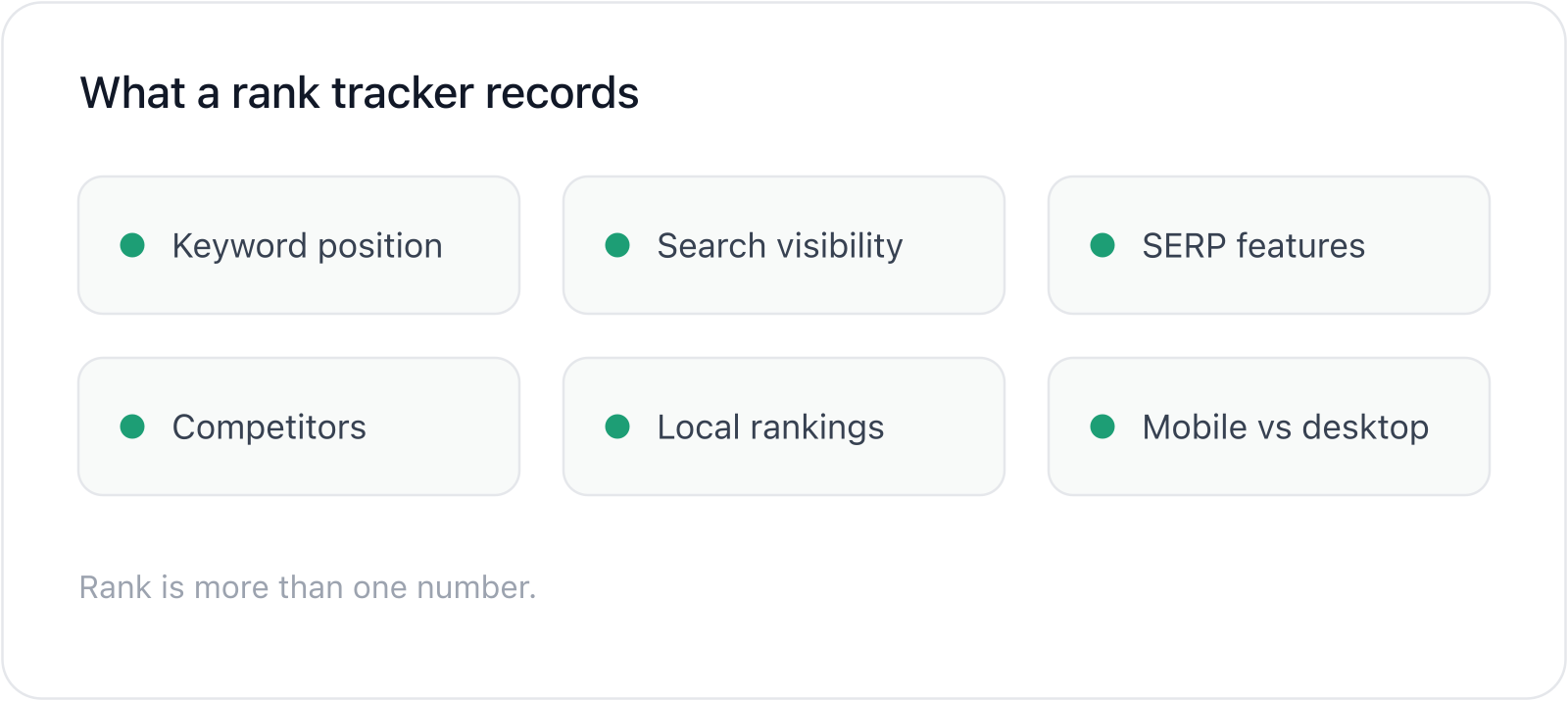
"Rank" sounds like a single number, but a useful rank tracker records more than one position. The full picture usually includes:
- Keyword position. Where each page ranks for each tracked keyword. This is the core metric, and it is what people mean by keyword rank tracking.
- Search visibility. A rolled-up score across all your keywords, so you can see overall direction in one figure instead of reading hundreds of rows.
- SERP feature presence. Whether you appear in features above the standard results, like featured snippets, image packs, video carousels, and AI Overviews. You can rank position one in the classic list and still be pushed down the page by these.
- Competitor positions. The same keywords tracked for your rivals, so rank becomes relative, not just absolute.
- Local rankings. For location-based searches, where you appear in the local pack and map results, which differ street by street.
- Mobile vs desktop. The two often diverge, and most searches are mobile, so tracking them separately matters.
You do not need all of these on day one. Start with keyword position for the terms that drive your business, then add competitors and SERP features as your program matures.
What a rank tracker recordsKeyword positionSearch visibilitySERP featuresCompetitorsLocal rankingsMobile vs desktopRank is more than one number.
Rank tracking vs keyword tracking vs SERP monitoring
These terms get used interchangeably, and the overlap causes confusion. The distinctions are simple once laid side by side.
| Term | What it watches | What it answers |
|---|---|---|
| Keyword rank tracking | Your position for specific keywords | "Where do I rank for the terms I care about?" |
| Rank tracking | Positions plus visibility, competitors, and SERP features over time | "Is my overall search visibility improving?" |
| SERP monitoring | The shape of the results page itself | "What does the results page look like, and what is winning it?" |
| AI visibility tracking | Whether AI answers mention and cite you, and which sources they pull from | "Do AI engines name me when people ask about my space?" |
Keyword rank tracking is the narrow core. Rank tracking is the broader program around it. SERP monitoring zooms out to the whole results page. AI visibility tracking is the newest layer, and it answers a question the other three cannot, which is the subject of the next two sections.
How to start rank tracking, and the mistakes to avoid
Setting up rank tracking is quick. Getting useful data out of it is where teams slip.
To start:
- Pick the keywords that matter. Focus on terms tied to revenue and intent, not vanity keywords with high volume and no fit.
- Set your locations and devices. Match where your customers actually search. A local business tracks city by city; a national brand tracks the country.
- Add your competitors. Two or three real rivals are enough to make your numbers relative.
- Choose a sensible cadence. Daily for fast-moving or competitive terms, weekly for the rest. More frequent is not always more useful.
- Read trends, not single days. One reading means little; the direction over weeks is the signal.
The common mistakes:
- Tracking too many irrelevant keywords, which buries the terms that matter in noise.
- Ignoring location and device differences, then wondering why the numbers do not match what users see.
- Reacting to daily fluctuations. Rankings wobble. Act on sustained moves, not single-day dips.
- Looking at rank in isolation. A position means little without traffic, conversions, and the context of what changed on the page or the SERP.
- Forgetting SERP feature displacement. Position one below three AI Overviews and a video carousel is not the position one of a few years ago.
That last point is the bridge to what is changing now.
Rank tracking is changing: from positions to AI visibility
For two decades, "ranking" meant a numbered spot in a list of blue links. That definition is fraying. A growing share of searches now end inside an AI answer, where there is no ranked list to be position three of.
- Google AI Overviews put a generated summary above the classic results, and the summary cites a handful of sources rather than ranking ten.
- ChatGPT, Perplexity, and Gemini answer questions directly, naming a few brands and linking a few sources, with no concept of "position one."
- Google AI Mode goes further, replacing the results page with a full conversational answer. It is newer and lower volume than classic search today, but the direction is clear.
In all of these, the question is no longer "what position am I?" It is "am I in the answer at all, and which sources did the engine trust to build it?" Classic rank tracking cannot see this. A tool can report you at position four for a keyword while an AI Overview answers the same query above you, citing three competitors and never mentioning you. Your rank looks fine. Your visibility is gone.
This is why the search for an AI rank tracker or an AI LLM rank tracker is rising: the job that rank tracking used to do, telling you whether you show up, now requires watching AI answers as well as the classic list.
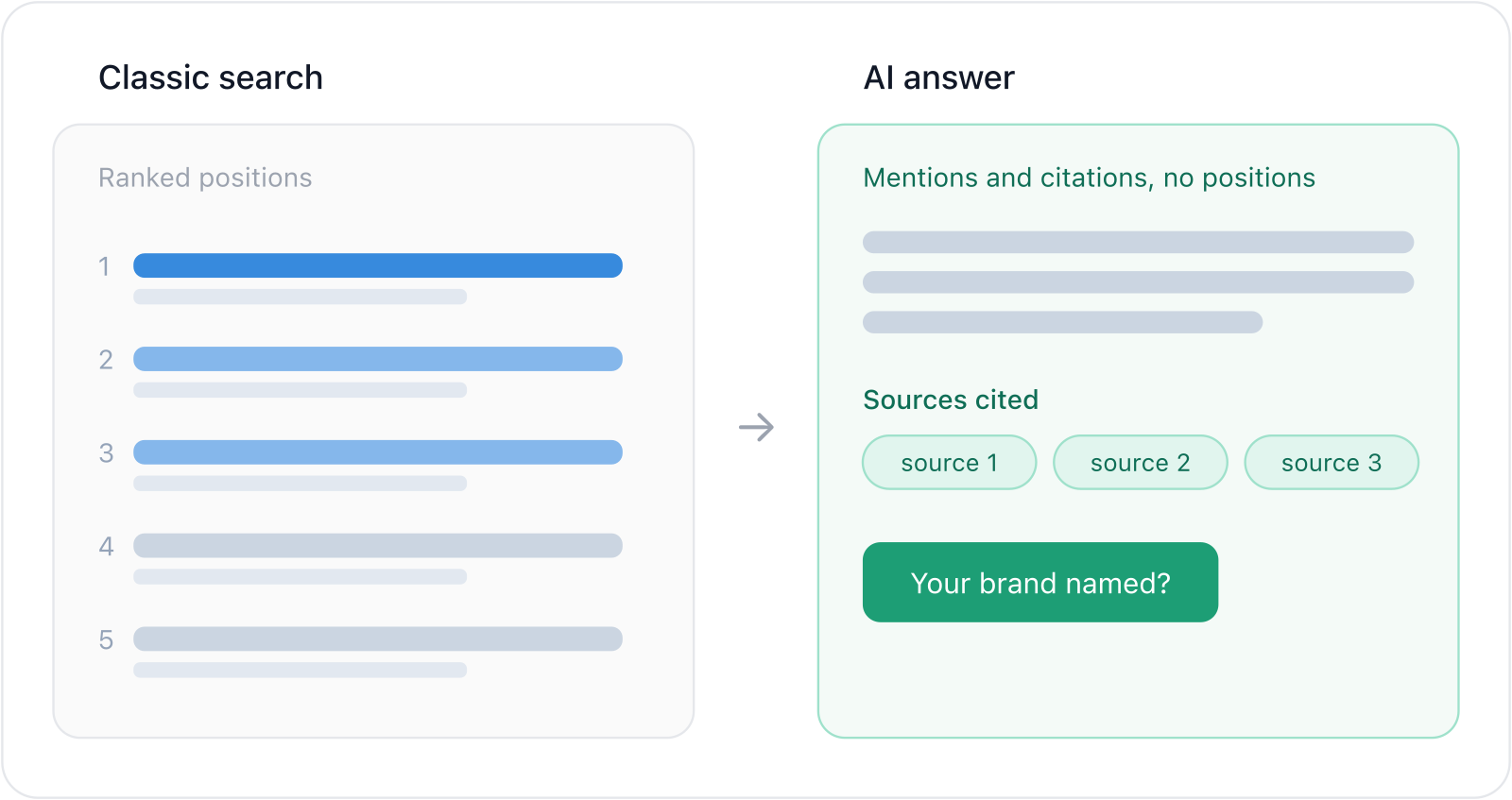
From ranked positions to presence in the answer.
Tracking presence in AI answers, not just position
Tracking AI visibility works on the same principle as rank tracking, run your queries on a schedule and record the result, but it measures presence and citations instead of a numbered position. This is what an AI visibility tracker does.
Instead of a rank, you watch:
- Mention. Does the AI answer name your brand when someone asks about your space?
- Citation and source. Which exact domains and URLs did the engine pull from to build the answer? This is the part classic tools cannot show, and it is the most actionable. Seeing the exact sources AI cites, not just a yes or no, tells you what to publish to earn a place in the answer.
- Share of voice. How often you appear versus competitors across the prompts your buyers actually ask.
- Movement over time. The same trend view rank tracking gives you, applied to AI answers.
AllSearch tracks this across ChatGPT, Perplexity, Gemini, Google AI Overviews, and Google AI Mode, gives you an AI Visibility Score benchmarked against competitors, and shows the source list behind every answer. From there, the work mirrors classic SEO: find the prompts you are losing, study the sources the engine cites, and close the gap with an AEO content strategy so you become one of the sources it trusts.
Rank tracking is still the right habit. The definition of "showing up" is just wider than it used to be. Track your classic positions, and track whether AI engines name and cite you, because increasingly that is where the search ends.
See where you stand. Get a free AI visibility report in under 60 seconds after a short setup, no guesswork about whether ChatGPT and AI Overviews mention you.
FAQs: Frequently asked questions
What is rank tracking?
Rank tracking is the practice of monitoring your website's position in search results for a set of target keywords and watching how those positions change over time. A rank tracker checks the results on a schedule and records where your pages appear, so you can tell whether your SEO work is improving visibility or losing it.
How does rank tracking work?
A rank tracker runs each of your keywords as a search on a repeating schedule, finds your domain in the results, and logs its position. It controls for location, device, and language so the data stays consistent, and it repeats daily or weekly to build a trend you can act on.
Why is rank tracking important?
It closes the SEO feedback loop with evidence. Rank tracking shows whether your changes are working, where the page-two keywords worth a push are, when something breaks, and how you compare to competitors. Without it, you are optimizing blind.
What is the difference between rank tracking and keyword tracking?
Keyword rank tracking is the narrow core: your position for specific keywords. Rank tracking is the broader program around it, adding overall visibility, competitor positions, and SERP feature presence tracked over time.
How often should you track rankings?
Daily for competitive or fast-moving keywords, weekly for the rest. The cadence matters less than reading the trend rather than reacting to single-day movements, which naturally fluctuate.
Why do my rankings differ from what I see when I search Google myself?
Your own searches are personalized by your location, search history, and the moment you search. A rank tracker strips that personalization out and checks from a clean, location-specific setup, so its number reflects a neutral search rather than yours.
Is rank tracking still relevant with AI search?
Yes, but it is no longer enough on its own. Classic positions still drive traffic, but a growing share of searches end inside an AI answer with no ranked list. You need to track both your positions and whether AI engines name and cite you.
How do you track rankings in AI engines like ChatGPT and Google AI Overviews?
You track presence and citations instead of a numbered position. An AI visibility tracker runs your prompts on a schedule and records whether the engine mentions your brand, which sources it cited, and your share of voice versus competitors across ChatGPT, Perplexity, Gemini, Google AI Overviews, and Google AI Mode.
Is there a free way to check rankings?
Google Search Console shows your average positions for queries you already rank for, for free. For AI answers, AllSearch generates a free AI visibility report in under 60 seconds after a short setup, showing whether AI engines mention and cite you.